Most photographers spend their careers chasing good light. Stuart Palley waits for the light to come to him — in the form of a wall of flame moving across a California canyon at night. Since 2013, across nearly 200 fires, he has built a visual archive of the American West’s fire crisis, and his ongoing series Terra Flamma is where that documentary instinct collides with something closer to fine art.
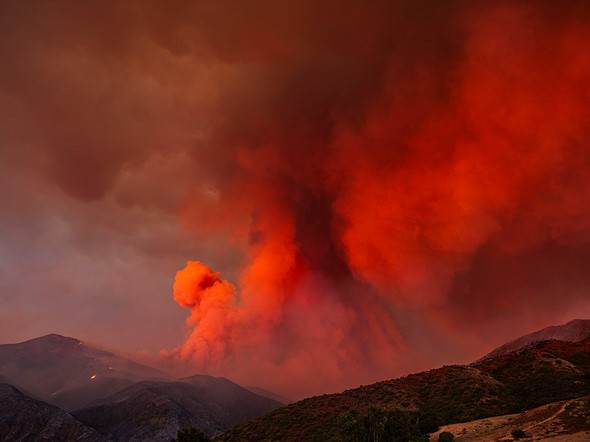
The concept is deceptively simple: long exposures of wildfires shot after dark. The results are anything but. Fire, Palley points out, is its own light source, and it behaves like a giant, unpredictable studio tool. “It bathes everything in this warm light,” he says. “When you add in smoke and other geographic features, it can either be an enormous warm softbox, or it can paint everything in orange and red, and then contrast it against a more blue or purple night sky.” Van Gogh’s The Starry Night is a direct reference point — Palley keeps returning to the painter’s line that the night is “more alive and more richly colored than the day.”
The technical demands are real. A 30-second exposure freezes almost nothing about a fast-moving fire, but it does something better: it maps where the smoke drifts and how embers scatter. His frames from the Airport Fire (Fujifilm GFX100 II, GF 20-35mm F4 R WR, 1/20 sec, ISO 800) and the Dragon Bravo Fire on the Grand Canyon’s North Rim (Nikon Z8, Nikkor Z 70-200mm F2.8 VR S, 30 sec, ISO 6400) show a photographer comfortable across two systems and every focal length from 20mm to 500mm.
Most long exposures are shot from a safe distance across a canyon — geography doubling as a safety buffer. Not always, though. During the January 2025 Eaton Fire in Altadena, Palley stood in the ember cast holding his camera for a 30-second exposure, protected by a hood, helmet and goggles. “It showed the ember cast in such a wild way that it was worth sitting there,” he says.
Gear pays the price. Palley has destroyed multiple cameras over the years — one dropped after a displaced beehive swarmed his yellow Nomex suit, and a fire once melted a lens hood — but the persistent enemy is smoke.