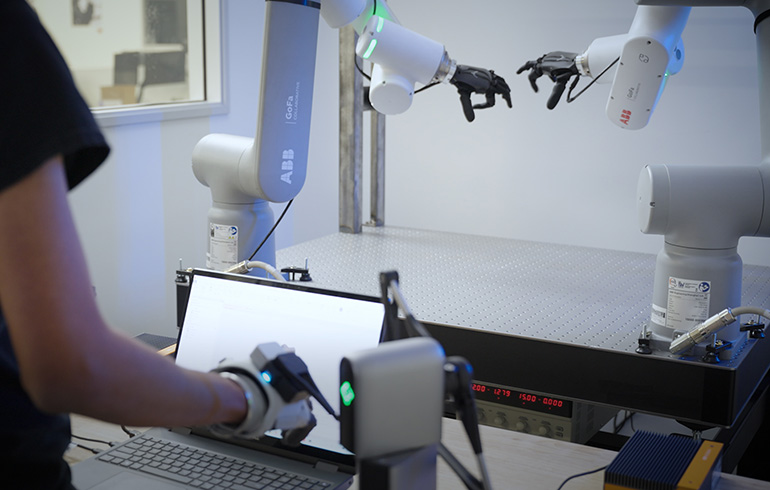
Robots are great at repeating a task a million times without complaint, but ask one to pick up an egg without turning it into an omelette and things get awkward. That’s the gap PSYONIC and ABB Robotics set out to close with a partnership announced on June 16, 2026, pairing PSYONIC’s Ability Hand with ABB’s GoFa collaborative arm.
The clever part isn’t just bolting a fancy hand onto a robot. PSYONIC’s Ability Hand was built for people — it’s a myoelectric prosthetic that reads muscle signals to drive a multi-articulating, lightweight design. Crucially, it combines touch sensing via pressure sensors with a vibration feedback system, and its compliant mechanics let the fingers give a little rather than crush whatever they’re holding. That’s the human-informed dexterity the partnership wants to transplant into industrial automation.
By mounting the hand on a GoFa cobot, the two companies aim to translate real manipulation data from prosthetics users into robotic grasping strategies. In other words, the way a person instinctively adjusts grip pressure, senses slip and eases off before something breaks becomes a dataset a robot can learn from. It’s a neat inversion of the usual flow — normally prosthetics borrow from robotics, but here the human-worn hardware is doing the teaching.
A few things are worth keeping in perspective. This is a research collaboration, not a shrink-wrapped product you’ll be ordering next quarter. The work is squarely in the development phase, exploring how compliant, sensor-rich grasping can make cobots more capable in tasks that demand a delicate touch. The Ability Hand itself is no impulse buy either — it retails between $25,000 and $50,000, reflecting its origins as advanced medical hardware rather than a factory-floor commodity.
The GoFa half of the equation is well suited to the experiment. As a collaborative robot, it’s designed to operate safely alongside people, which pairs logically with a hand engineered around human interaction and feedback. Combine the two and you get a testbed for the kind of nuanced, force-aware manipulation that rigid grippers struggle with.
There’s a broader momentum here, too. PSYONIC later unveiled a three-way collaboration with NVIDIA and ABB Robotics at Automate 2026, signalling that this isn’t a one-off tie-up but part of a wider push to bring touch-driven intelligence into automation. That trajectory — prosthetics know-how feeding robotics, backed by serious silicon for the learning side — hints at where dexterous manipulation is heading.
- Ability Hand: myoelectric control, pressure sensors, vibration feedback, compliant multi-articulating design
- ABB GoFa: collaborative robot arm serving as the platform
- Goal: apply human manipulation data to improve robotic grasping
- Status: research collaboration, announced June 16, 2026
For now, the promise is clear even if the finished product isn’t: give robots a sense of touch borrowed from people, and that egg finally stands a chance.