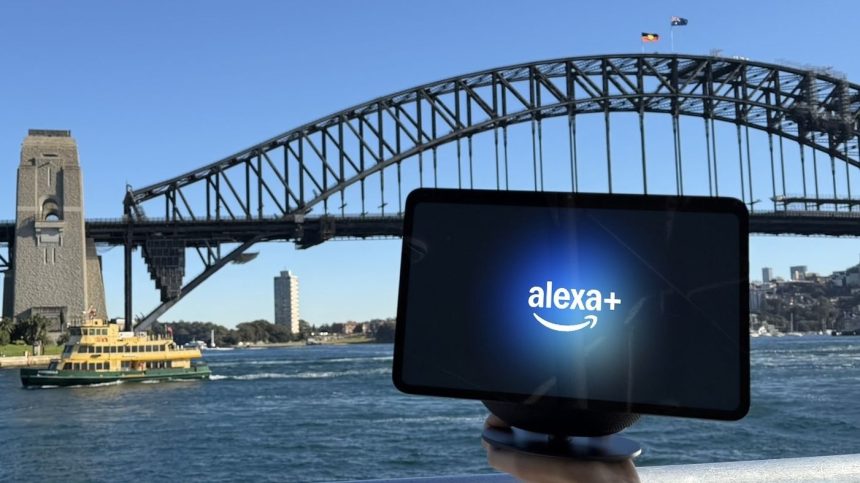
Amazon’s generative-AI overhaul of its long-serving voice assistant has crossed the Pacific. As of today, August 6, 2026, Alexa+ has begun rolling out in Australia, arriving with a party trick that should raise a few eyebrows in Sydney and Perth alike: it actually understands the local vernacular. Slang, idioms and that famously casual Aussie cadence are all part of the package.
For anyone who’s spent years barking rigid commands at a smart speaker and getting a stony “I don’t know that one” in return, Alexa+ is meant to feel like a genuine conversation partner. Amazon describes it as “smarter, more conversational and more capable” than the assistant it replaces — and the technical backbone explains why.
Under the hood, Alexa+ runs on advanced large language models delivered through Amazon Bedrock, the same class of technology powering ChatGPT and Claude. That shift from scripted responses to genuine natural-language understanding is the whole point. Rather than parsing keywords, the assistant follows the thread of a conversation, remembers your preferences and can act on your behalf to complete tasks — the so-called “agentic” behaviour that every tech giant is currently racing to ship.
The practical upshot is that you can speak to it the way you’d speak to a person: trailing sentences, mid-thought corrections and colloquialisms included. For the Australian launch, Amazon has tuned it to recognise regional turns of phrase and respond in kind, rather than defaulting to a clipped, neutral tone.
Then there’s the question that follows every AI subscription these days — is it worth paying for? Here’s how the numbers shake out:
- Amazon Prime membership costs $9.99 per month
- US$19.99 per month as a standalone subscription in the US (£19.99 in the UK, €22.99 in Europe)
- AU$29.99 per month as a standalone option without Prime
In other words, if you’re already a Prime subscriber, Alexa+ is bundled in — a fairly compelling pitch. If you’re not, the monthly fee puts it in direct competition with a growing crowd of paid AI assistants, and the value calculation gets murkier.
The Australian arrival is being handled as a staged rollout rather than a flip-the-switch launch. Alexa+ is currently in an early access phase, which Amazon plans to run until November 30, 2026. That gives the company a runway to refine how well the assistant actually copes with Australian speech in the wild before opening the floodgates.
Whether a chattier, LLM-powered Alexa is enough to reinvigorate the smart-home assistant category — or just another recurring charge on the pile — will come down to how reliably it handles the messy, unscripted way people really talk. For now, at least, it’s finally learned to say “g’day” and mean it.