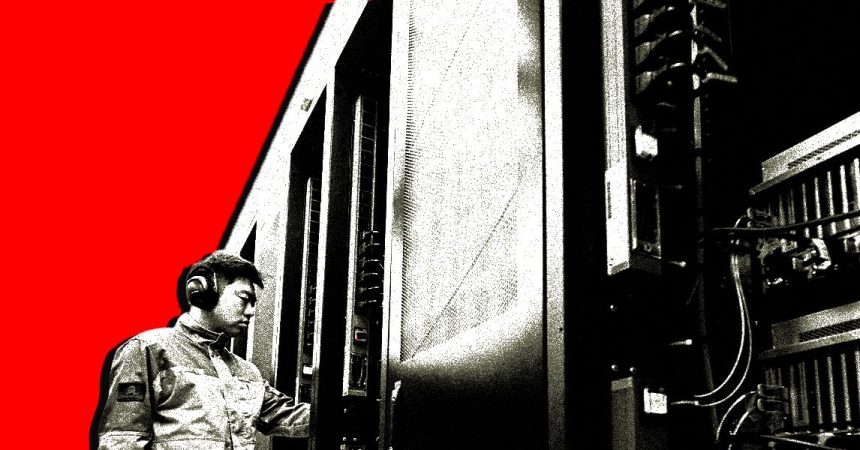
Take a two-hour train ride west of Beijing and the skyline of the capital gives way to the rolling grasslands and ancient cinder cones of Inner Mongolia. This is sheep-farming and coal-mining country — and, increasingly, the hottest address in China for building AI data centers.
The epicenter is Ulanqab, a city of roughly 1.5 million people. Since 2016, nearly 100 data centers have opened or broken ground there. According to a Goldman Sachs research note published last week, Chinese companies have committed to projects totaling an estimated 12.5 gigawatts of capacity, with more than 70 percent of those pledges made in just the past year. For scale, OpenAI’s $500 billion Stargate Project is slated to hit only 10 gigawatts when finished.
Why here? Geography does a lot of the heavy lifting. Sitting high on the Inner Mongolian Plateau, Ulanqab endures long, cold winters, which slashes the energy needed to keep servers cool. It’s close enough to Beijing to serve China’s populous eastern regions with minimal latency. And crucially, electricity is cheaper here than almost anywhere else in the country, thanks to booming wind and solar generation stacked on top of abundant coal.
The more telling shift is who is doing the building. For the first time, Chinese AI companies are pouring money into their own infrastructure rather than renting compute from cloud providers. DeepSeek is reportedly constructing a massive facility in Ulanqab, and so are ByteDance, Alibaba, and Xiaohongshu. After years of spending far less on physical hardware than their American rivals, Chinese AI firms are finally closing the gap.
There is one stubborn obstacle: water. Ulanqab is about as dry as Denver, seeing only roughly 14 inches of rain per year. The local government is already straining to meet resident demand — last month, the city’s water company shut off several waterworks for seven hours each night to blunt peak usage, and that’s before many planned projects even go live. Government weather data shows the centers only need extra cooling water two months out of the year, but the sheer volume of new infrastructure still poses a real environmental headache.
The region isn’t a newcomer to servers. Huawei built its first Ulanqab data center in 2016, and Apple followed in 2019. In 2021 the area became a key hub of the national “Eastern Data, Western Compute” program. Early on, distance from coastal users made these sites useful mostly for backup storage — until AI training, which tolerates high latency during months-long runs, gave them a purpose. Two dedicated fiber-optic cables, laid in 2017 and 2019, have since cut average latency below five milliseconds, enough to support real-time inference.
The government also sees the boom as a way to soak up surplus renewable power. This month, wind-turbine giant Envision announced a 2 gigawatt AI data center in Ulanqab wired directly to its own clean supply. Still, experts urge caution: much of Ulanqab’s electricity still comes from coal, and around-the-clock operations have long favored fossil fuels for reliability.