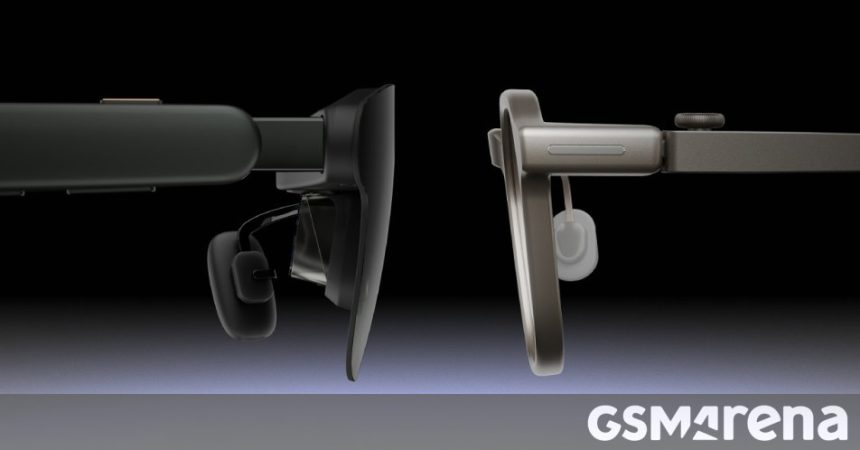
RayNeo isn’t shy about its position in the AR race — with a 23.7% market share in Q1 2026 (per Counterpoint), the company just doubled down with two fresh product lines that pull in opposite directions. One wants to whisper useful information into your day; the other wants to plaster a cinema screen across your field of vision.
The RayNeo iO Smart Glasses are the productivity play. This is the pair built for the person who wears smart glasses from breakfast to bedtime. At just 33g, they’re engineered around an even 50:50 weight distribution between the front and the temples, which is exactly the kind of nerdy detail that decides whether a device is comfortable after eight hours or ends up in a drawer.
The materials list reads like an aerospace shopping cart: AZ91D magnesium-aluminum alloy frames paired with aerospace-grade titanium temples. Visuals come from a monochrome (green) waveguide display driven by RayNeo’s Firefly Nano Engine — deliberately minimalist, tuned for glanceable, ambient information rather than binge-watching. Think notifications, navigation cues and quick data hits, not a Netflix marathon.
The iO is priced at US$479 for the standard case, or US$529 if you want the charging case bundle. It goes on sale September 4, 2026.
Then there’s the GT Series, which takes the opposite philosophy and runs with it. This is RayNeo’s cinema-grade line, split into two models:
- RayNeo GT — 68g, priced at US$299
- RayNeo GT Max — 78g, priced at US$399
The GT Max is the showpiece. It offers a 59-degree field of view and lets you scale a virtual screen across 227-inch, 267-inch, and 307-inch sizes, so you can size your personal theater to taste. The headline feature, though, is that the GT Series is the first AR glasses to support Dolby Vision — a genuine milestone for wearable displays, and a clear signal that RayNeo wants these to be taken seriously as a portable big-screen replacement.
Both GT models also go on sale September 4, 2026.
What’s interesting here isn’t just the hardware — it’s the split strategy. Rather than trying to build one pair of glasses that does everything (and inevitably does nothing especially well), RayNeo is offering two distinct answers. The iO is for people who want technology to disappear into their day; the GT Series is for people who want technology to take over their eyeballs with a Dolby Vision movie. Different jobs, different faces, one company.
With prices ranging from US$299 to US$529 across the four SKUs, RayNeo is also keeping the barrier to entry lower than you might expect for glasses touting titanium temples and Dolby Vision. Whether the displays live up to the spec sheets is something we’ll be keen to test once they’re on shelves.