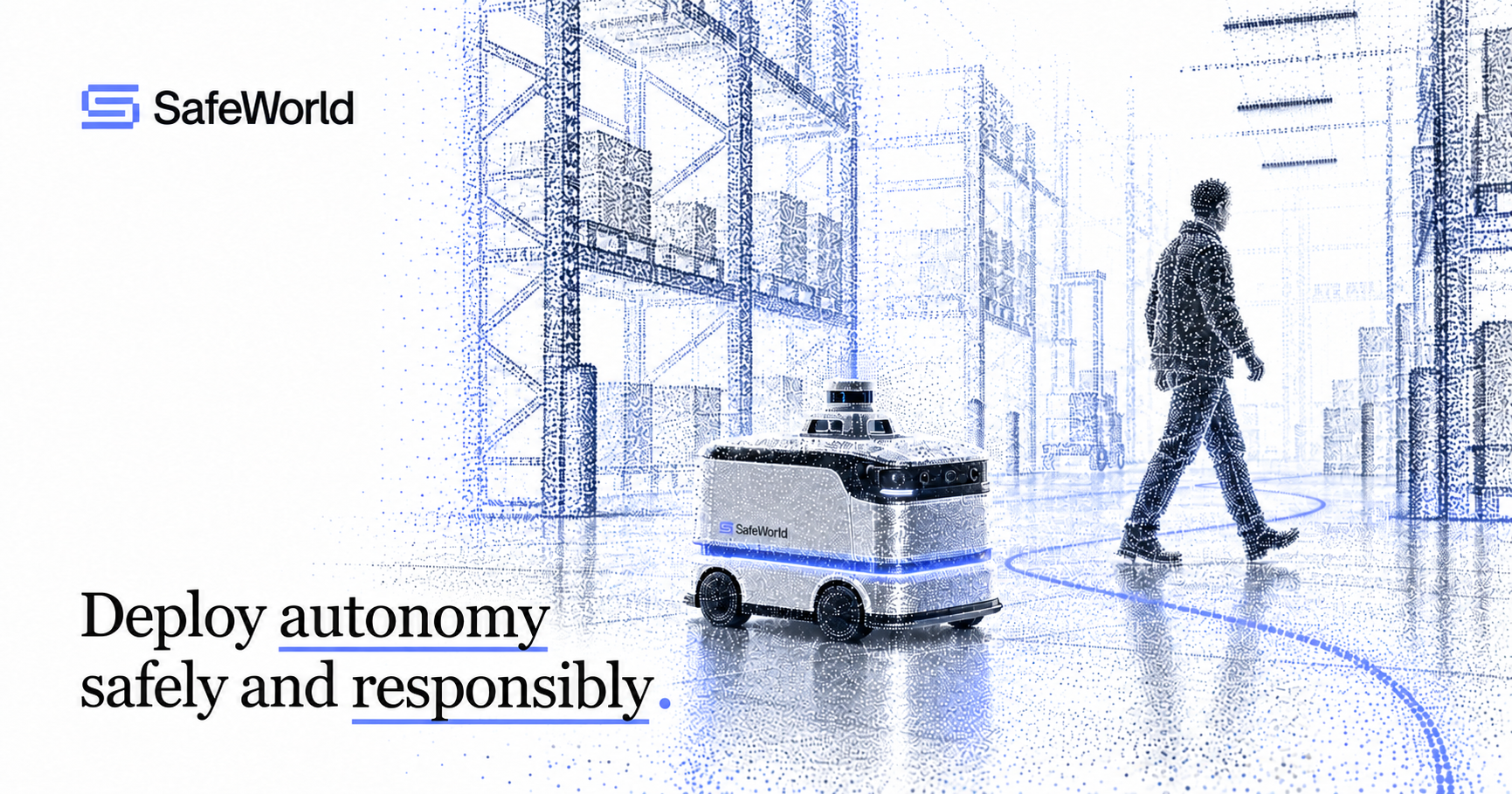
Before a robot shares a warehouse aisle with people, someone has to show it won’t run into them. Usually the robot maker builds that proof itself, scenario by scenario. SafeWorld wants to sell it as a product instead. The startup came out of stealth on October 5, 2026 with $12.2 million in seed funding to build simulation and testing software for robots that work around humans.
The round was co-led by Shine Capital and a16z Speedrun. Box Group, the Carnegie Mellon University Endowment, Innovation Endeavors and SV Angel also took part, along with Ovo Fund, Valkyrie, Zelda Ventures, Alpha Square Group, Founders Future and Brave Capital. Founders and executives from Nvidia, Google DeepMind, Waymo, Meta, DoorDash and Salesforce invested as well.
Who is behind it
SafeWorld has three co-founders. CEO Kyle Wong previously founded Pixlee and served as CEO of StartX. Dr. Ding Zhao directs the Safe AI Lab at Carnegie Mellon University and is a former Google DeepMind researcher. Simo Rachidi is a repeat founder who used to be a principal security and machine learning engineer at Salesforce Einstein. The company calls itself an AI lab focused on robot safety.
How the platform works
The main idea is that you shouldn’t need a simulation specialist to stress-test a robot. According to the company:
- Test scenarios are built in a web browser from past incidents, safety standards and the robot’s own logs, with no simulation expertise required.
- The platform runs a robot through thousands of variations of each scenario, with reactive, realistic human motion.
- It measures how well the robot performs on safety in each run.
- Tests can be rerun continuously whenever the software is updated or the robot moves to a new environment.
SafeWorld says it supports robot arms, humanoids, mobile robots and other machine types. That covers most of the hardware now heading for factories and logistics centers.
Early customers
The Robot Report says SafeWorld works with about six companies, two-thirds of them publicly traded. They span industrial, manufacturing, logistics and construction work, plus some home use cases. The funding announcement mentions early pilots with major automotive OEMs, warehouse automation leaders and medical device makers. Thomas Tang, CEO of Anyware Robotics, said simulation tools like SafeWorld give his company “a scalable way to test challenging scenarios.”
Wong’s advice on timing is simple. If deployment is less than a year away, it’s time to think about safety. Companies that already have hardware in the field, and he names Caterpillar as an example, need safety work from day one. Software-first teams can wait until they reach real-world deployment. Without that work, Wong told The Robot Report, “you’re not going to deploy those robots.”
Why a third party
Wong and Zhao argue that an independent safety provider builds the trust customers, regulators and the public need before AI-driven robots can be deployed widely. SafeWorld plans to spend the new money on wider enterprise adoption and a bigger team. It also plans to fund or promote open-source AI safety research. The website does not list pricing; companies are invited to request access.