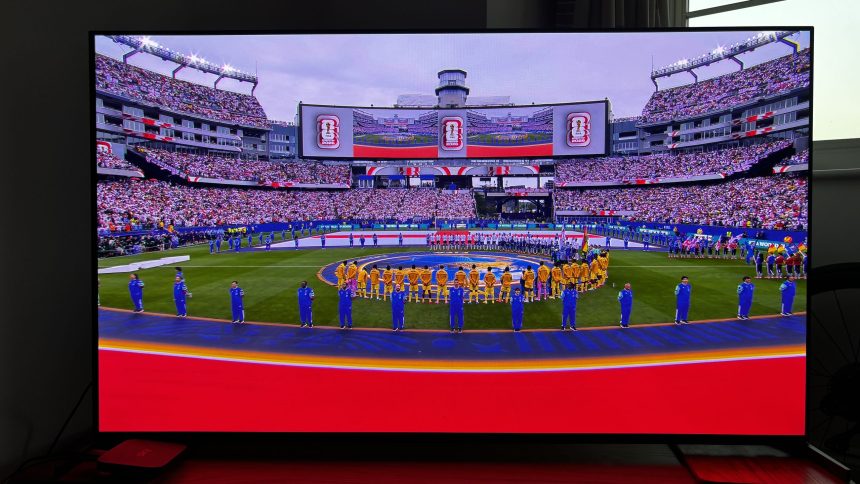
Forget Tom Cruise dangling off an aeroplane in glorious 4K. If you really want to know what your TV is made of this summer, point it at 90 minutes of World Cup football. Soccer, it turns out, can nutmeg even the slickest flatscreen — and the 2026 tournament is throwing everything it has at your panel.
The most obvious challenge is motion. Players sprinting across the pitch, the ball arcing toward goal, cameras snapping between wide-angle and close-up shots — it all demands serious processing muscle. A TV that can’t keep up smears the action into a colourful mess. Push the motion processing too hard, on the other hand, and you invite the dreaded soap opera effect, where interpolated frames make everything look unnervingly smooth and artificial. The good news: modern sets handle this far better out of the box, and most still give you plenty of settings to tweak as backup.
Sharpness gets a workout too. There’s detail everywhere — individual blades of grass, the studs and laces on a player’s boots, sponsor logos and names stitched onto shirts. Cut to the studio and your TV turns its attention to presenters’ outfits, set furniture and, if they’re lucky enough to be outdoors, a sprawling cityscape backdrop.
Then there’s brightness and contrast. Watch the kits closely: if the contrast is overcooked, whites blow out until shirts, shorts and even the white lines on the grass lose all their detail. Go too far the other way and the manager’s black tracksuit collapses into a textureless blob. The best panels strike a balance — dark enough to preserve shadow detail, bright enough to keep subtlety intact. Experiment with both settings, because nudging one always affects the other.
Stadiums themselves conspire against your TV. When half the pitch bakes in blistering sunshine while the rest sits in the shadow of the stands, you’ll often catch the picture wobbling as the camera decides what to prioritise. That’s not always your TV’s fault, either.
Colour is the final frontier. Bold, saturated kits are easy enough to handle, but subtle shades are where cheaper sets stumble — particularly skin tones. With those US heatwaves producing plenty of flushed faces, the question is whether players look naturally hot and bothered or cartoonishly overblown.
One important caveat: before you blame your hardware, check the source. Bitrate and broadcast handling vary wildly between channels, and the same match can look noticeably softer on one than another. In our experience, ITV’s pictures tend to look lower quality than the BBC’s.
So rather than reaching for a calibration disc, use this year’s tournament to fine-tune your set. Watch the motion, study the kits, scrutinise the shadows — and you might be surprised by what your TV can (and can’t) do.