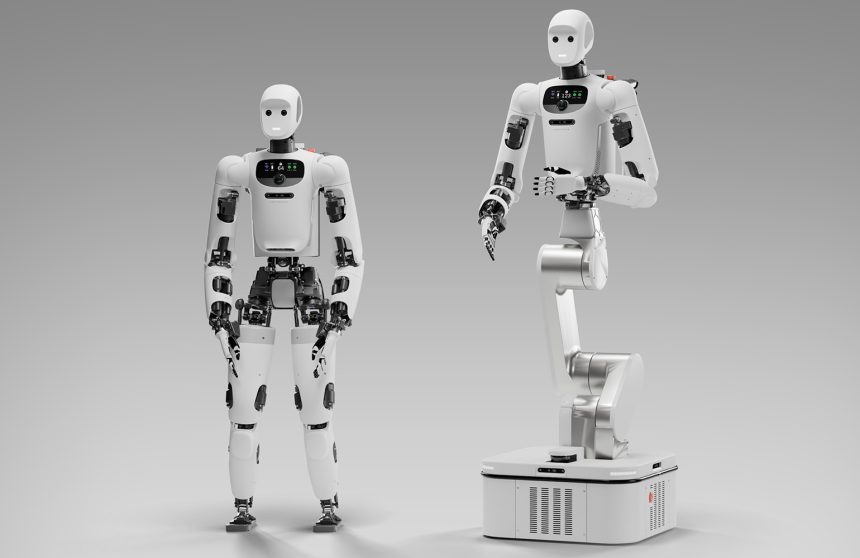
Apptronik has pulled back the curtain on Apollo 2, a humanoid robot that isn’t just built to work — it’s built to learn how to work. Announced on June 30, 2026, the machine is pitched as a continuous data collection and training platform, meaning every shift it pulls is also a lesson that feeds back into its own capabilities.
Here’s the twist that separates Apollo 2 from a splashy reveal: it isn’t fresh out of the lab. The robot has been quietly clocking in for more than a year as a data-gathering platform, hoovering up diverse experience across different tasks and environments. That real-world grind is the whole point — Apptronik wants Apollo 2 to acquire skills the way a human worker does, through repetition and exposure rather than hand-coded routines.
Physically, the robot stands 173 cm tall and weighs 73 kg, with a payload capacity of 25 kg — enough to make it genuinely useful on a factory or warehouse floor. It comes in two flavors: a bipedal version for spaces designed around human movement, and a wheeled-base configuration for environments where rolling beats walking.
Under the shell, Apptronik leans on its patented actuator technology, engineered for 90%+ energy efficiency while staying friendly to mass manufacturing and a resilient supply chain — a not-so-subtle nod to the fact that a humanoid is only as good as the number you can actually build and keep running.
Speaking of keeping it running, Apollo 2 uses a swappable battery architecture. Instead of parking the robot for hours to recharge, operators can hot-swap packs to keep workflows uninterrupted, with opportunity charging and tethering options layered on top. For anyone eyeing round-the-clock deployment, that’s arguably as important as anything the robot does with its arms.
The other half of the announcement is a place, not a product. Apptronik opened a nearly 90,000-square-foot facility called Robot Park in Austin, Texas, also on June 30, 2026. Think of it as a proving ground and training gym rolled into one: a flagship site where fleets of robots collect data at scale, sharpening their skills before — and during — real deployments. It underscores a broader shift in the humanoid race, where the winners may be decided less by who has the flashiest hardware and more by who can gather and process the most operational data.
Pricing hasn’t been disclosed, which is par for the course at this stage of the humanoid market. But the message from Apptronik is clear enough: Apollo 2 is designed to be deployed, to improve while deployed, and to scale. Whether it can turn a year of quiet data collection into a robot that genuinely earns its keep is the question Robot Park exists to answer.