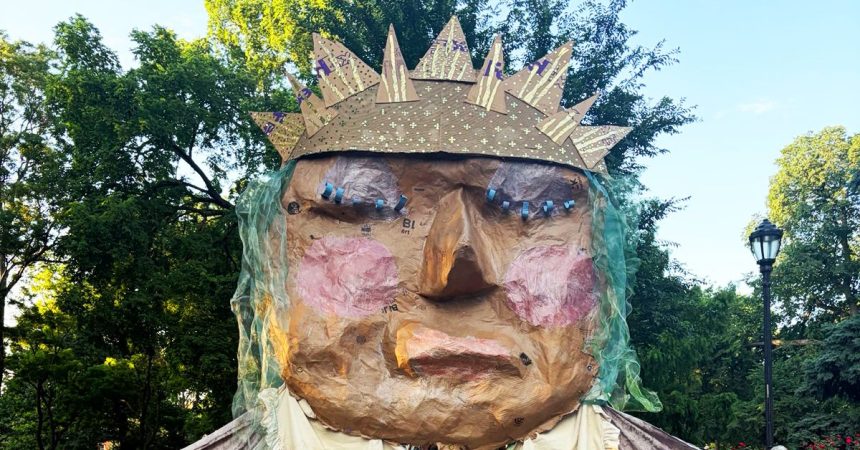
In the middle of Tompkins Square Park, hundreds of people gathered in front of a giant papier-mâché face of a crowned woman — the handmade backdrop to a play about 19th-century textile workers who smashed the machines that threatened their livelihoods. This is the Summer of Ludd, a free, week-long anti–Big Tech festival running through July 5 in New York’s East Village, and the first rule announced to the crowd of roughly 300 was simple: no phones, no recording, no photos.
None of the week’s events were advertised online. Posters around the neighborhood declared “only in real life!,” while printed booklets tucked into community spaces spread the schedule the old-fashioned way. The programming reads like a manifesto against the always-on economy: workshops on mending, flirting and dating offline, learning to fight against data centers, plus a hands-on shortwave radio and walkie-talkie session for long-distance chatting. The Museum of Interesting Things partnered up to screen 16-mm films, and a table of zines covered everything from ditching Spotify to “Why GenAI Sucks.”
The festival even has a mascot-slash-spokesperson: Gowanus, a blue cloth puppet with soda-cap eyes, deployed so the anonymous organizers can talk to the press without revealing themselves. According to Gowanus, the group is a “loose” collection of organizers who began planning in January, “coalescing around noticing similar problems of alienation and overreliance on Big Tech.”
The movement has become closely tied to Gen Z — the first generation raised entirely online, and increasingly wary of it. A 2025 Pew Research study found that in 2024, 48 percent of teen respondents said social media has negative effects on people their age, up from 32 percent in 2022. But the crowd skewed broader than that: Pride-goers, families and East Village veterans mingled, one explaining to a younger attendee the anti-fascist history of “Bella Ciao” after the orchestra played it.
The politics run deep. The festival overlaps with a Luddite conference at the New School, where speakers discussed AI’s role in the military “kill chain,” and Dan Fox — who works for a dumbphone company — announced a “platformless” run for president. Yet many attendees framed their rebellion in personal terms.
- Damian Thomas, who runs Unplatform, argues today’s technicians rent their infrastructure much as Luddites once rented big machines — pointing to Claude Code and SaaS as the modern equivalent.
- A former Big Tech security engineer said he quit after leadership pushed non-technical staff to ship AI-generated code to production.
- At “Google in Real Life,” attendees answered each other’s questions in person; one read tarot cards for anyone curious.
Andrew Maynard, a professor at Arizona State University, notes the original Luddites cared about labor, not tech itself — but he doubts festivals like this will change much. “Even when people agree that they think these technologies are harmful, it rarely impacts the way they live their lives,” he says. Still, as Thomas puts it: “We are where public opinion is.”