Construction sites are chaotic, dangerous places — and that makes them a brutal proving ground for physical AI. On June 16, 2026, Built Robotics and the xLAB (Safe Autonomous Systems Lab) at the University of Pennsylvania announced a research collaboration aimed squarely at that problem, with a shared goal of making autonomous machinery safer around the people who work beside it.
The partnership pairs an established autonomous equipment company with an academic lab that specializes in provably safe autonomous systems. The idea is straightforward, even if the execution is anything but: get more real-world data, feed it into better AI models, and use those models to keep workers out of harm’s way.
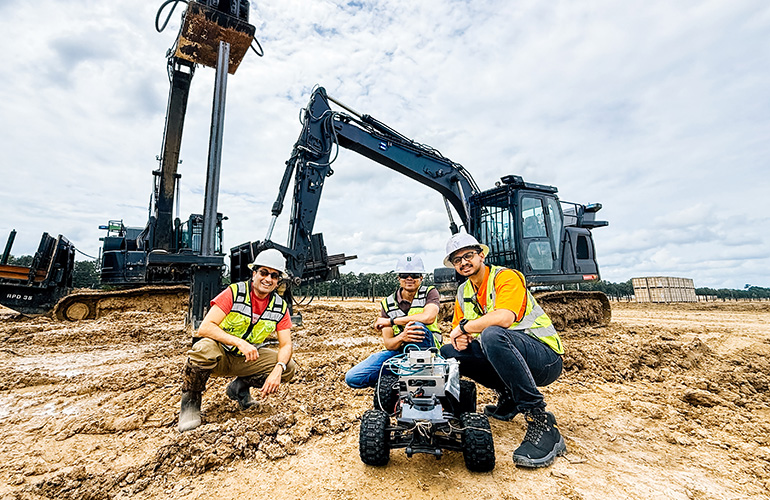
The initial deployment centers on Built Robotics’ edge AI model, which will run across a fleet of construction survey robots operating on active solar projects. Running inference at the edge — on the machine itself, rather than in a distant data center — matters here. Safety-critical tasks like personnel detection can’t wait on a round trip to the cloud; a robot deciding whether a person just stepped into its path needs an answer in milliseconds, not seconds.
As those survey robots move across job sites, they’ll gather sensor data during normal operation. That’s the clever part of the setup: the robots aren’t just doing a job, they’re building a training corpus. The results are intended to sharpen the underlying AI models, and — crucially — the improvements are meant to carry over to other vehicle platforms, not just the survey units that collected the data.
Why solar projects? They tend to be large, repetitive, outdoor environments with plenty of moving equipment and human crews — exactly the kind of setting where autonomous machines and people share space and where detection has to be rock solid. It’s a practical testbed for a system that eventually needs to generalize.
A few things worth flagging for the skeptics:
- This is research, not a product. There’s no consumer gadget, no price tag and no retail launch attached to this announcement.
- The focus is safety first. The headline priorities are personnel detection and human safety, powered by proprietary edge AI.
- Data is the real deliverable. The near-term win is a richer dataset that lifts model performance across a broader fleet.
Physical AI — the branch of the field where models have to reason about the messy, unpredictable real world rather than tidy text or images — is one of the hardest frontiers in robotics. Construction, with its blend of heavy machinery, shifting conditions and human unpredictability, is an unforgiving place to test it. Which is precisely why it’s a good one. If an autonomous system can be trusted here, the lessons should travel well beyond the job site.
For now, the collaboration is an ongoing initiative, with the survey-robot fleet doing double duty as workforce and data-gathering platform.