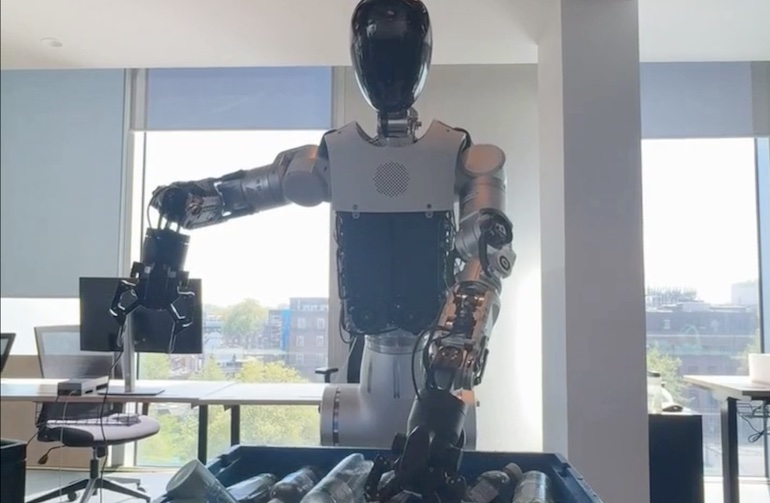
Getting a robot to reliably pick up, place and manipulate objects sounds trivial until you watch one drop a part for the thousandth time. UK-based robotics and AI company Humanoid says its new reinforcement learning approach, KinetIQ Ascend, is closing that gap fast, pushing manipulation reliability toward levels that were previously the exclusive domain of human hands.
Announced on June 29, 2026, KinetIQ Ascend is not a gadget you can put on a shelf. It’s a training methodology — the software brains behind the muscle — designed to make humanoid robots dependable enough for real industrial work rather than staged demos.
The headline claim is bold: 99.9% manipulation reliability at human speed and beyond. In factory terms, that’s the difference between a novelty and a machine you can actually put on a production line without babysitting it.
What makes the story more than a marketing line is the trajectory. According to Humanoid, success rates climbed from 78% to 99% — roughly a twentyfold reduction in failures. The part that should make competing labs sit up: those gains landed after only a few days of training.
The secret sauce is old-fashioned trial and error, scaled up. KinetIQ Ascend builds on the company’s earlier KinetIQ platform, letting robots learn directly from attempting industrial tasks and adjusting based on what works and what doesn’t. Instead of hand-coding every motion or scripting rigid routines, the system rewards behaviors that succeed and prunes the ones that flub the job. Repeat that loop fast enough and the robot effectively teaches itself dexterity.
Why does a twentyfold cut in failures matter so much? Because reliability is the tax that keeps humanoids stuck in the lab. A robot that succeeds 78% of the time is a liability on a factory floor — every fifth attempt is a stoppage, a dropped component or a jam. Nudge that figure into the high 99s and the economics flip. Suddenly the machine can keep pace with human workers on repetitive manipulation tasks without constant supervision.
A few caveats are worth keeping in mind. These are Humanoid’s own figures, and manipulation reliability is notoriously sensitive to the specific task, object and environment. A 99.9% success rate on one well-defined operation doesn’t automatically transfer to the chaos of a busy warehouse. Reinforcement learning also tends to shine in narrow, repeatable scenarios and struggle when conditions drift far from the training set.
Still, the direction of travel is clear. The bottleneck for humanoid robots has never really been walking or looking impressive — it’s the boring, fiddly business of handling objects reliably, thousands of times, without error. If KinetIQ Ascend delivers what Humanoid claims, that bottleneck just got a lot narrower, and the case for putting humanoids to work on real industrial tasks gets harder to dismiss.