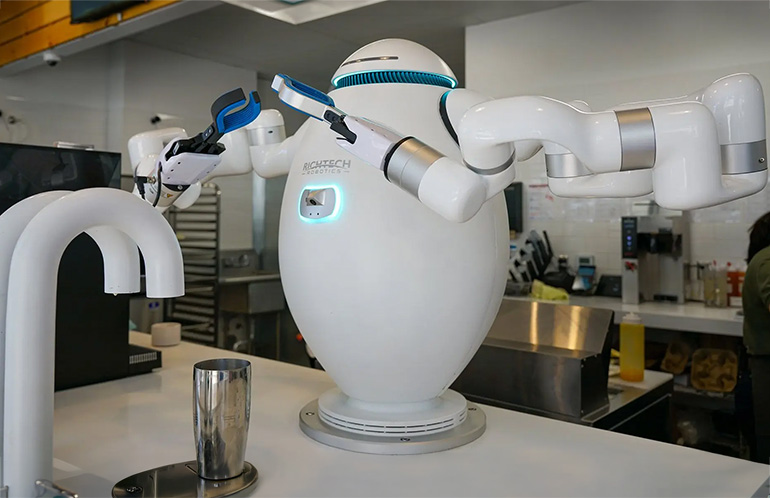
Want to chat with a humanoid robot without leaving your couch? Richtech Robotics has thrown open the doors to its AI-powered service robot ADAM, launching a round-the-clock livestream that lets anyone on the planet interact with the machine in real time.
The stream, which went live following the June 18, 2026 announcement, runs 24/7. That means there’s no schedule to catch and no queue to join — global audiences can drop in at any hour to watch ADAM at work and engage with it directly. For a category of technology that usually lives behind trade-show glass or inside sealed R&D labs, that kind of open, continuous access is a genuinely bold move.
Under the hood, ADAM leans heavily on NVIDIA’s robotics stack. The humanoid was developed on the NVIDIA Isaac open robotics platform, the same framework NVIDIA pitches as a foundation for training and simulating intelligent machines. For onboard brains, ADAM runs on NVIDIA Jetson Thor, the company’s compute module built specifically for physical AI and humanoid workloads. Put simply: the perception, decision-making and dexterity you see on the stream are being handled by silicon designed to keep pace with a machine that has to move, react and interact on its own.
ADAM isn’t a lab curiosity or a walking tech demo, though. Richtech markets it as a commercial service robot aimed at hospitality, with beverage preparation as a headline skill. Think of it less as a research showpiece and more as a working barista — one that Richtech deploys through rental and deployment partnerships rather than selling outright.
A few things worth clearing up. There are, confusingly, two very different robots called Adam floating around: a research humanoid from Beijing-based PNDbotics, and the service robot we’re talking about here from Richtech Robotics Inc. (Nasdaq: RR). They’re unrelated, so don’t mix them up.
As for cost, Richtech hasn’t published a retail price for ADAM in dollars, pounds or euros. That tracks with its business model — the robot is offered as a deployable service through partnerships, so there’s no unit sticker price for consumers to eye up.
What the livestream really signals is confidence. Letting the wider public poke at, question and interact with a humanoid continuously is a far cry from a scripted keynote reel. If ADAM can hold up under an unpredictable global audience day and night, it says more about the maturity of the underlying NVIDIA-powered platform than any spec sheet could. And for anyone curious about where humanoid service robots are actually heading, the invitation is refreshingly simple: log on and ask ADAM yourself.