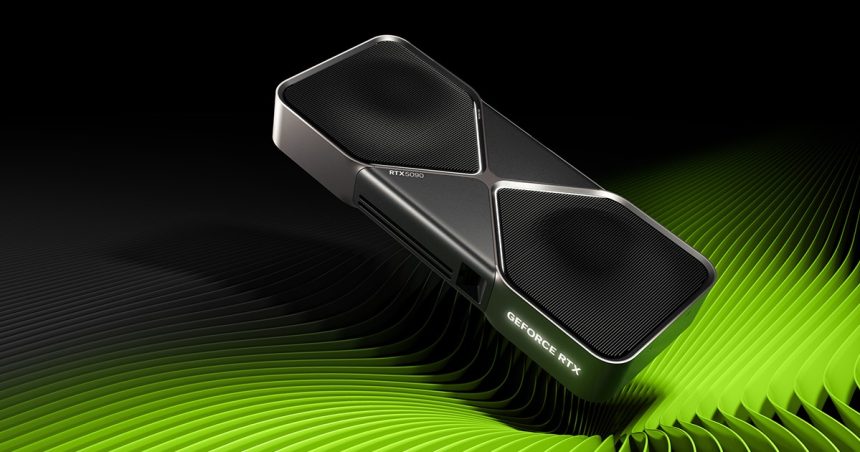
If you’ve built your dream rig around a GeForce RTX 5090, you probably splurged on a riser cable to show off Nvidia’s flagship behind a tempered-glass side panel. That’s the aesthetic play. But there’s a caveat worth knowing before you route that PCIe extension: riser cable setups can be a genuine source of trouble with this particular card.
To be clear about the severity — this is not in the same league as the melting 12VHPWR power connector saga that has haunted Nvidia’s high-end GPUs. Nobody is telling you your cable is about to catch fire. But the RTX 5090 is a demanding beast, and demanding beasts don’t tolerate sloppy signal paths. Proceed with caution.
The reasoning is mostly physics. The 5090 rides on the PCIe 5.0 interface, and PCIe 5.0 signaling is far less forgiving than the older 4.0 or 3.0 standards. Longer traces, extra connectors and lower-quality shielding all introduce signal degradation. On a card of this caliber, a mediocre riser can lead to link instability, dropped lanes or the system quietly negotiating down to a slower speed — none of which you paid US$1,999 to experience.
And this is a card that leaves nothing on the table. Consider what you’re feeding through that ribbon:
- Architecture: Nvidia Blackwell
- Memory: 32 GB GDDR7
- CUDA cores: 21,760
- Memory bandwidth: 1,792 GB/s
- Boost clock: 2.41 GHz (base 2.01 GHz)
- Power draw: 575 W
That 575 W figure is the other half of the story. A riser cable only handles the data link — power still runs through the 12VHPWR connector — but the sheer heat and load of a fully stressed 5090 make any weak point in the chain more likely to reveal itself. A cheap riser sitting near a scorching card is not where you want to cut corners.
If you’re set on the clean-cable look, the practical advice is straightforward: buy a PCIe 5.0-rated riser from a reputable maker rather than the cheapest listing you can find. Keep the run as short as possible, avoid sharp bends that stress the internal wiring, and seat both ends firmly. If you start seeing crashes, artifacts or lower-than-expected benchmark numbers, plug the card directly into the motherboard slot as a diagnostic step — that alone will tell you whether the riser is the culprit.
The RTX 5090 launched on January 30, 2025 and famously sold out globally within five minutes. Owners who fought that hard for a card owe it to themselves not to bottleneck it with a US$15 accessory. The connector may be convenient, but on a GPU this powerful, convenience without quality is a gamble.