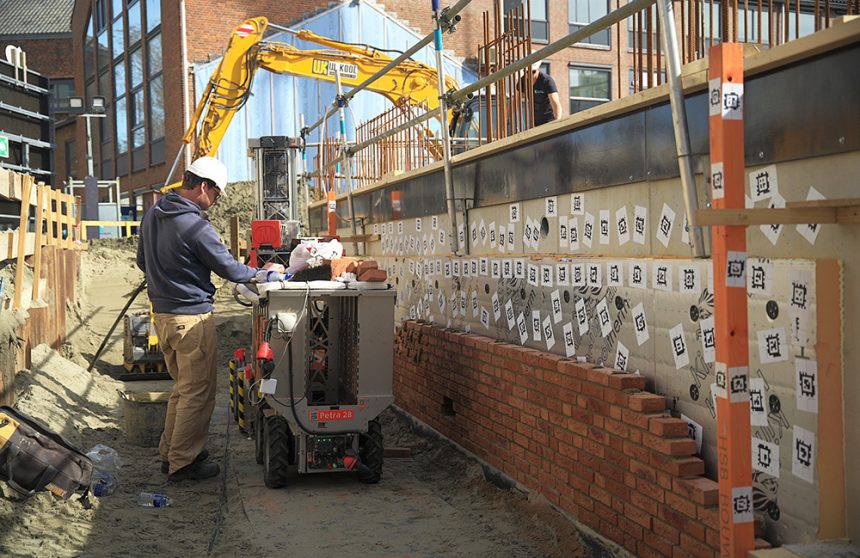
Forget buying robots — Monumental would rather sell you a finished wall. The Amsterdam-based construction robotics company has just closed a $32 million Series B round, and it’s channeling the cash into an American debut planned for this year.
The pitch is refreshingly straightforward. Instead of shipping expensive hardware to contractors and hoping they know how to operate it, Monumental deploys its own machines as an autonomous subcontractor. Builders pay for the result — meters of completed masonry — under a pay-per-wall model. The robots stay with Monumental; the walls stay on the job site.
Under the hood, these are electric, autonomous units that lean heavily on advanced sensors, computer vision, and onboard cranes to lay brick and mortar with millimeter precision. Coordinating the fleet is an AI software platform called Atrium, which handles the planning and choreography that turns a stack of bricks into a structurally sound wall. It’s the kind of tight hardware-software loop that separates a genuine robotics play from a glorified power tool.
And this isn’t a lab demo. Monumental already runs a fleet of more than 150 robots working as autonomous subcontractors on real construction sites. Its track record spans the walls of more than 100 homes across the Netherlands and the UK, plus a school, a community centre, a hotel, and even canal walls — the sort of varied, unglamorous work that proves a system can cope with more than a single repeatable task.
The U.S. expansion targets four states to start:
- Texas
- Florida
- Virginia
- Arizona
The choice tells its own story. These are high-growth housing markets with plenty of new construction and persistent shortages of skilled masons — exactly the conditions where a robot that shows up, lays brick to spec, and bills by the wall starts to look less like a novelty and more like a business necessity.
Construction has long been one of automation’s toughest nuts to crack: every site is different, conditions are messy, and precision matters enormously. Monumental’s bet is that by owning the whole operation — robots, software, and the labor itself — it sidesteps the adoption hurdle that has stalled so many construction-tech ventures. Contractors don’t need to retrain crews or maintain machines; they just book a wall.
With fresh funding and a proven European fleet behind it, the company is now betting that American builders will find the same math compelling. The robots have already earned their keep on more than a hundred homes. Whether they can scale that discipline across four sprawling U.S. states is the next question — and one the industry will be watching closely.