Forget the notion of a balloon as a simple weather instrument drifting wherever the wind pleases. The latest experiments have turned the high-altitude balloon into something far more ambitious: an airborne carrier that loiters for weeks at the edge of space and then releases solar-powered drones on command.
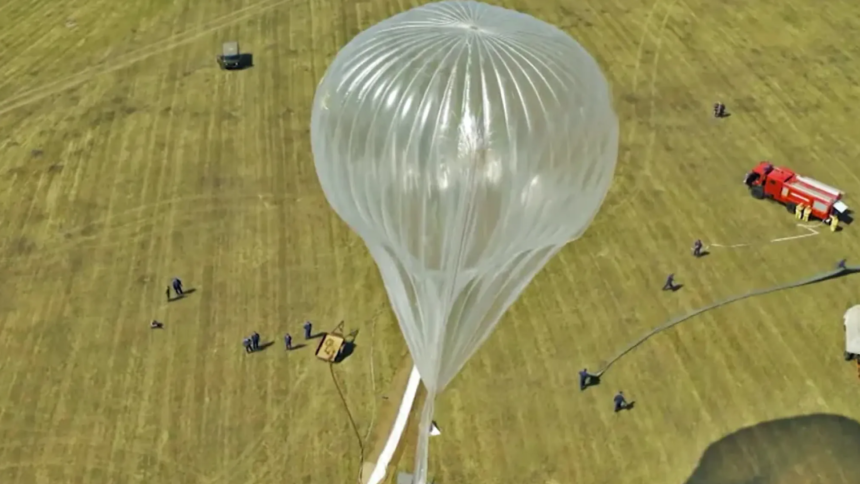
The proof of concept comes from pairing an Aerostar Lightning balloon with an Icarus Apollo-R drone. The Lightning platform stays aloft for up to three days at altitudes between 50,000 and 78,000 feet, hauling payloads of up to 45 pounds. That’s enough to ferry an Apollo-R up into the thin air and let it go — a task recent testing confirmed, with a balloon cleanly releasing a single high-endurance uncrewed aircraft while cruising through the open stratosphere.
If three days sounds modest, the bigger sibling changes the math entirely. The Aerostar Thunderhead covers a similar altitude band — 55,000 to 75,000 feet — but can remain airborne for 60 days or more. It also lifts considerably more, with payloads weighing up to 200 pounds. That capacity is the interesting part: instead of a single drone, a Thunderhead can carry and launch several Apollo-R aircraft across one long mission.
The Apollo-R itself is no throwaway. The solar-powered design can climb to 60,000 feet and stay airborne for weeks at a time, sipping sunlight to keep going long after conventional fuel would have run dry. That endurance, stacked on top of a two-month balloon deployment, hints at persistent coverage measured in months rather than hours.
The appeal here is economics as much as endurance. Balloons are cheap to fill and float, and the Apollo-R lands in the low-six-figure range — steep for a gadget, but a bargain compared with crewed aircraft or satellites for equivalent loiter time over a fixed area.
There is, inevitably, a catch, and it blows in from the stratosphere itself. Winds up there are notoriously unpredictable, and a balloon has no engine to fight them. Precise station-keeping and navigation remain the central engineering headache, which is why the drone matters so much: the aircraft can be steered where the balloon cannot.
This is very much a government and military story rather than a consumer one. On June 24, 2026, Army soldiers launched an Icarus Apollo-R stratospheric aircraft from an Urban Sky balloon, one of several tests that have nudged the carrier-balloon idea from slideware toward something operational.
None of this is heading to a store shelf, and there’s no retail price for the Aerostar hardware. But as a demonstration of clever systems thinking — turning a wind-tossed balloon into a launch platform for self-sustaining solar drones — it’s a genuinely elegant piece of high-altitude engineering.