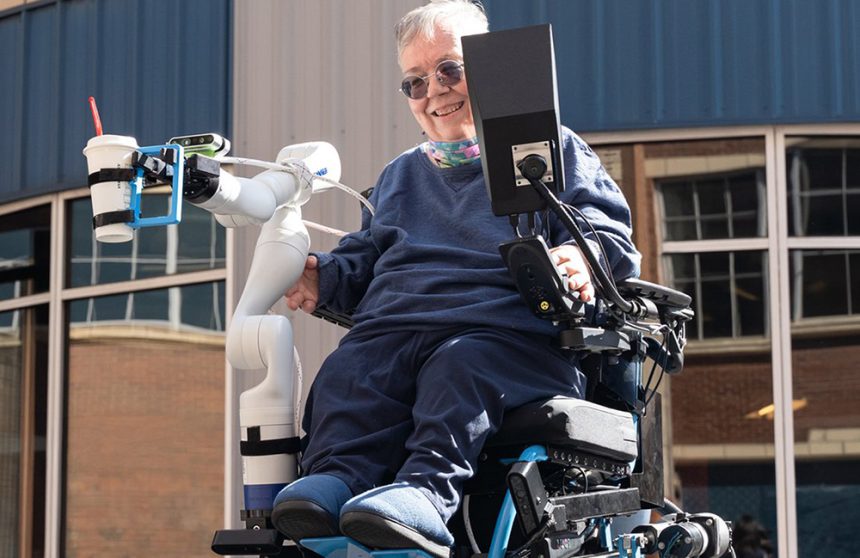
Most power wheelchairs stop at getting you from A to B. ATDev wants to build one that also grabs the cereal box off the top shelf, retrieves a dropped phone and generally handles the reaching-and-lifting chores that usually require a caregiver. The company, spun out of UC Berkeley in 2020, has been sharing progress on its next-generation robotic wheelchair platform — and it’s shaping up to be one of the more ambitious assistive-tech projects around.
The core idea is a modern power wheelchair paired with a coordinated robotic arm. Rather than bolting on a clumsy manipulator that fights the chair for control, ATDev is engineering the two to work as one system. The arm handles tasks the user can’t easily do themselves, while the chair provides mobility — the whole point being to give users more independence and reduce day-to-day reliance on others.
Under the hood, ATDev is leaning on a stack of technologies that until recently lived mostly in research labs:
- Advanced robotics for the coordinated arm and chair movement
- Artificial intelligence to interpret tasks and act on them with a degree of autonomy
- Digital twin simulation, which lets the team model and test behaviors virtually before committing them to hardware
That digital-twin approach is worth dwelling on. Building and iterating on a physical robotic wheelchair is slow and expensive; a virtual replica lets engineers rehearse how the arm reaches, how the chair balances load and how the two coordinate — then refine everything in software before a single motor spins in the real world. For a safety-critical device that carries a person and manipulates objects near them, that kind of pre-testing matters.
The program isn’t a solo effort. ATDev’s robotic assisted wheelchair is being developed as part of the RAMMP program, awarded to the University of Pittsburgh under ARPA-H for up to $41 million. ARPA-H is the U.S. agency modeled on DARPA but aimed at health breakthroughs, and its involvement signals that this is being treated as serious infrastructure for accessibility rather than a novelty gadget.
A few practical caveats. The platform is still firmly in development — there’s no finalized model name yet, no announced price, and it isn’t available to buy. That’s typical for a device at this stage, especially one working through the rigorous validation an assistive medical product demands. What ATDev is offering right now is a look at the trajectory: where the technology stands and where it’s headed.
If the concept lands, it points toward a shift in what a wheelchair even is — from a passive mobility aid to an active robotic partner that extends the user’s reach, literally. The gap between a chair that moves you and a chair that helps you live independently is exactly the space ATDev is trying to close.