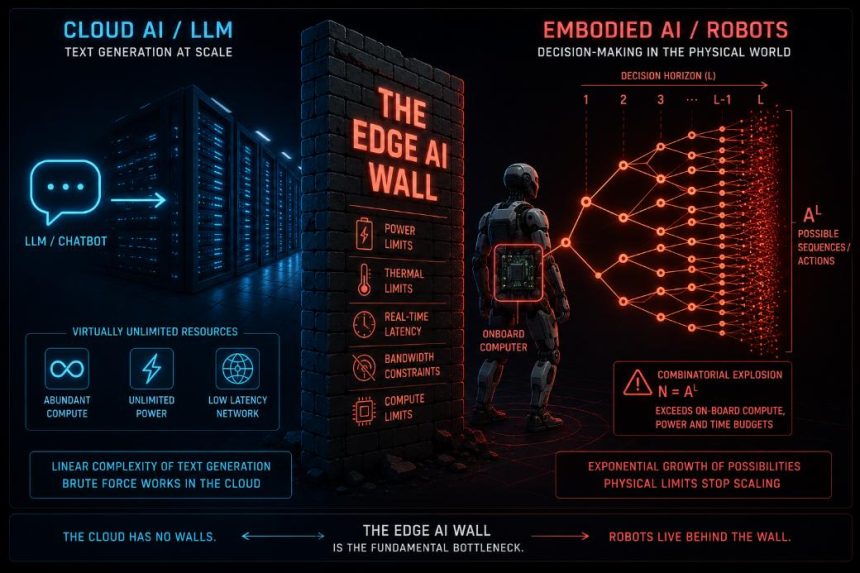
Every impressive robot demo hides an uncomfortable truth: the machine is usually thinking too slowly, or too expensively, to survive outside a controlled lab. That bottleneck now has a name — the edge AI wall — and a growing camp of researchers argues it is not a quirk of one badly written motion planner, but a fundamental limit standing between us and genuinely useful embodied AI.
The core problem is computational overload. When a robot has to perceive the world, predict how objects will move, and plan its own actions in real time, the number of possible combinations it must weigh explodes. Cloud servers can brute-force their way through that complexity, but a robot operating at the edge — on a power budget, without a fat network link, and with hard deadlines measured in milliseconds — simply cannot. Physical AI lives or dies on latency, and the wall is where latency and energy costs meet an immovable ceiling.
What makes this argument interesting is the claim that no amount of faster silicon will save us. Throwing more GPUs at an exponentially growing search space only buys a little breathing room before the same wall reappears. The proposed way out is not better hardware but better mathematics.
Two ideas anchor that pitch:
- The Duality-Nonequilibrium (DN) model — a theoretical framework that reframes how an embodied system represents and reasons about a physical world that is never actually at rest.
- Combinatorial Compression Engine (CCE) algorithms — methods designed to squeeze the combinatorial blow-up down to something an edge processor can actually handle in real time.
Put simply, instead of asking a robot to evaluate every possible future, these approaches try to compress the problem itself before it ever reaches the processor. If the search space can be mathematically collapsed rather than exhaustively explored, the wall stops being a hard ceiling and becomes something you can walk around.
It is worth being clear about what this is and isn’t. This is a research direction and a conceptual framework, not a chip you can buy or a robot you can pre-order. But the framing matters for anyone watching the humanoid and service-robot gold rush. The industry loves to showcase machines that fold laundry or wander warehouses, yet many of those systems quietly lean on remote compute or heavily scripted environments precisely because the edge AI wall is real.
If the DN model and CCE algorithms — or something like them — pan out, the payoff would be robots that reason locally, react instantly, and don’t need a data center on a leash. That is arguably the difference between a viral demo and a product that ships. For now, the takeaway is a healthy dose of skepticism: the next leap in embodied AI may come less from a shinier processor and more from rewriting the math it runs.