Most photographers pull over before they shoot. Henry Wessel kept driving. Commuting from his home in the East Bay to a teaching job in San Francisco, he worked out that the morning and evening light gave him an opportunity to photograph while on the road — so he adapted his camera for one-handed use and made pictures through the open window of his car. His justification was disarmingly simple: “a glance was enough.”
That body of work is the spine of Henry Wessel: Photographs and Books, a spotlight exhibition at The Grolier Club in New York, on view in the Second Floor Gallery from September 8 through November 14. The show gathers more than 65 photographs by Wessel (1942–2018), including two of his portfolios in their entirety.
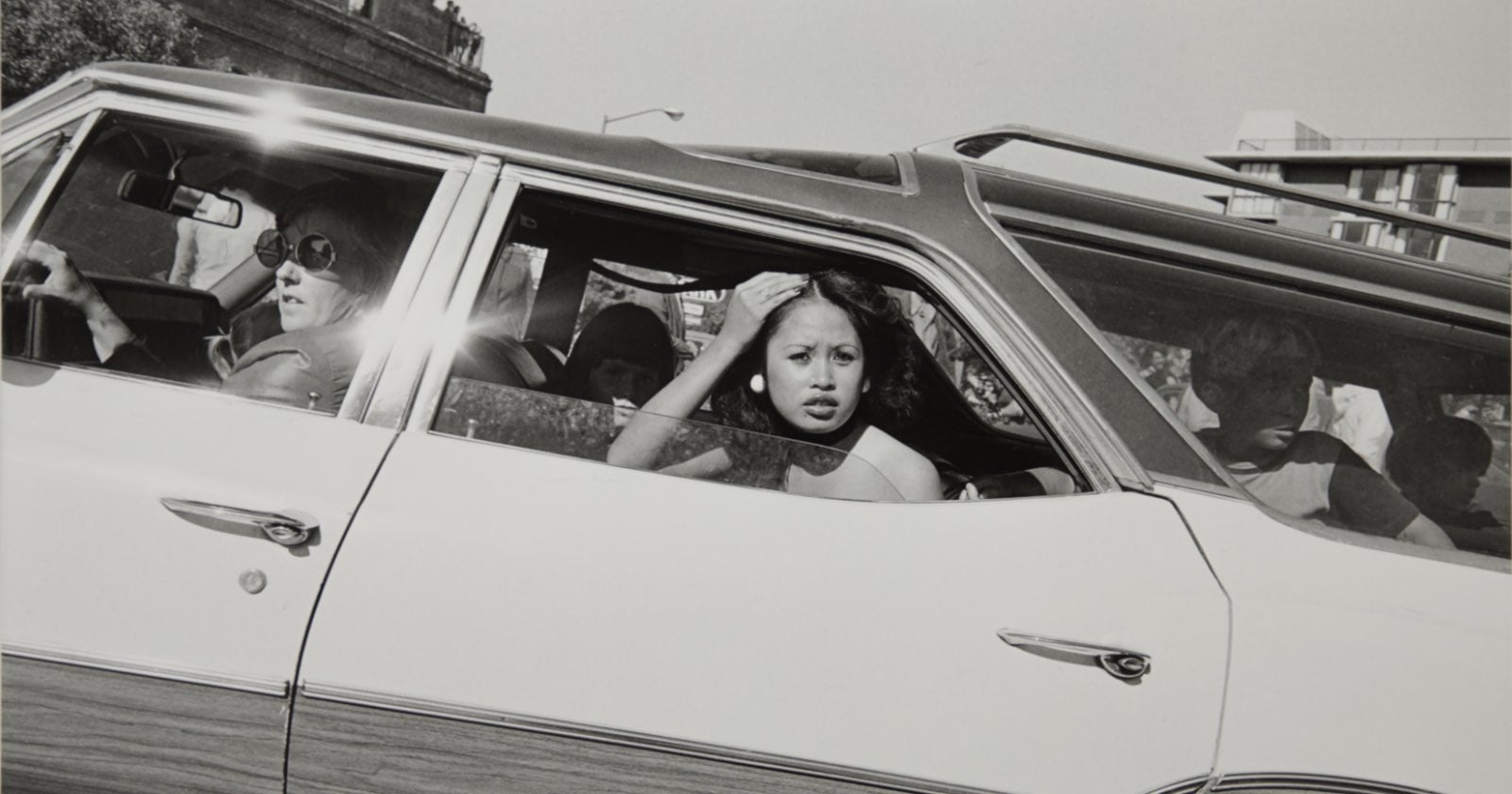
The first is Traffic — 28 black-and-white photographs made in the 1980s and issued as a portfolio in 2017. Every frame is a person in a car, photographed from another car. It is a technically absurd premise (two moving vehicles, one hand on the wheel, no second chances) that Wessel turned into a routine, to the point where he began looking forward to the commute as working time rather than dead time.
The second is Incidents, assembled in 2012 from 27 black-and-white photographs Wessel made over several decades. None of them had been published or exhibited before. They catch brief moments of everyday California life, frequently in hard sunlight; in Incidents No 5 (undated), passengers in a car seem to surface out of the shadows the longer you look. As the Deutsche Börse Photography Foundation has noted, the pictures feel spontaneous and yet strangely cinematic — Wessel almost never photographed people looking back at him, preferring to work from behind or at close range without being noticed, so each image reads like a film still with something just off the edge of the frame.
Two further projects are represented. Real Estate was Wessel’s first sustained project in color, and it returned him to the subject he had been circling since his first roll of film: houses, photographed from a car window. Night Walk started in 1995, when he was walking his dog after dark in the Sunset Park neighborhood of Los Angeles and became fixated on what artificial light does to a street. “The spot lighting of particular areas, the lack of ambient light, the unnatural way that shadows are cast, all take us to an unfamiliar place, a world that is stage-like with its implied drama,” he said.
The exhibition is curated by Grolier Club member Jack Gray from his own collection. Gray first met Wessel in 1976 as one of his undergraduate students at the San Francisco Art Institute, started collecting the work while still a student, and a chance meeting 20 years later turned into a long friendship.
- Venue: The Grolier Club, 47 East 60th Street, New York, NY 10022, Second Floor Gallery
- Dates: September 8 – November 14, 2026
- Admission: free of charge; exhibitions open Monday–Saturday, 10 am to 5 pm
- Panel discussion: Wednesday, October 28, 6:30 pm – 7:30 pm, moderated by Jack Gray with photographer and writer Tod Papageorge
- Catalogue: published by The Grolier Club, available autumn 2026
Wessel described the camera as an indulgent medium precisely because it asked so little of him up front: “The preparation to work is almost nonexistent.” Fifty-odd years of American road light later, that turns out to have been the whole method.