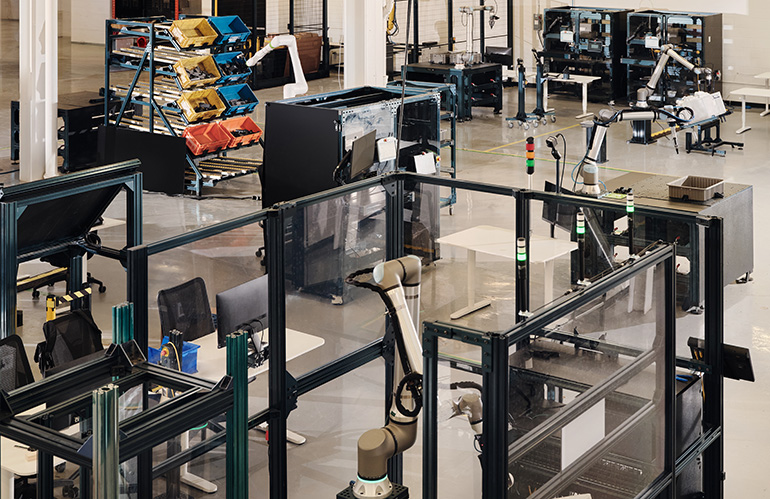
Making a robot arm look brilliant in a demo hall is easy. Making it repeat the same grasp on a night shift, on a line that keeps changing parts, is the hard part — and that gap is exactly what Vention has built a new facility around. On September 9, 2026 the Montreal company opened its Physical AI Lab, a research operation aimed squarely at robotic manipulation, from experimental models to deployments that survive a real production line.
The pitch is not another research showcase. It is access to data. “Any physical AI foundation model is data-hungry. We move several hundred robot cells a year, and they all collect high-quality industrial manipulation data,” said CEO Etienne Lacroix. That is the loop the lab is designed to close: research feeds into live production problems, and what breaks on the factory floor comes back as a research question. “Physical AI will fundamentally expand what manufacturers can automate, but the challenge is no longer proving robots work in labs — it’s making capabilities reliable and deployable,” Lacroix added.
The lab’s flagship output so far is GRIIP, the Generalized Robotic Industrial Intelligence Pipeline, launched in February 2026. Vention describes it as an end-to-end Physical AI pipeline that lets robots perceive, reason and act in unstructured, unpredictable manufacturing environments. On the company’s product page the stack covers:
- scene digitalization and automatic calibration;
- object segmentation in cluttered bins;
- 6DOF pose estimation with sub-millimeter accuracy;
- grasp intelligence that evaluates hundreds of grasp candidates;
- collision-free motion planning.
Vention claims GRIIP needs zero training data, deploys from CAD files within minutes, handles mixed SKUs and part variation without custom programming, and reaches 99% pick success rates. It leans on foundation models from NVIDIA alongside Vention’s own, and a public GRIIP SDK is planned.
Running the lab is Dr. Jimmy Li, Director of Physical AI, a robotics and machine learning researcher out of McGill University. “What makes this lab different is the loop we’ve built: academic research feeding directly into live production problems, and production feedback feeding back into research,” he said. Dr. Joelle Pineau, Chief AI Officer at Cohere and formerly VP of research at Meta, joins as external technical advisor. The team currently stands at eight people, with more than 16 open positions across robotics control, simulation and Physical AI research, spanning motion planning, classical computer vision, vision foundation models, learning from demonstration and reinforcement learning.
The business case behind the hiring is blunt: Physical AI is Vention’s fastest-growing segment, with related revenue up 400% year over year, much of it from kitting work in automotive, aerospace and consumer electronics. The company says it has deployed over 28,000 machines globally across a community of more than 6,000 factories, including 90 Fortune 500 companies, and counts NVIDIA and Teradyne Robotics among its partners.
Earlier on GismoLand: Vention teams with FANUC and Universal Robots on software-defined automation.