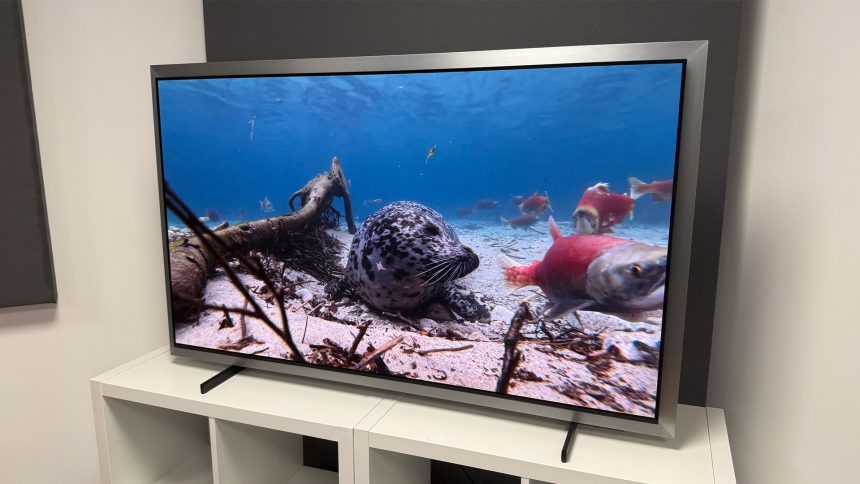
Buying a flagship OLED TV in 2026 has become a game of patience versus impulse. Samsung’s newest top-tier panel has just had its price cut, and on paper it carries all the hallmarks of a halo product — the kind designed to sit at the very top of a lineup and dominate spec sheets. But here’s the twist: the smarter purchase right now may be the older flagship sitting quietly in the shadows.
That alternative is Sony’s Bravia 8 II, an award-winning OLED that has already earned a five-star verdict. While Samsung’s freshly discounted set chases the latest-and-greatest crown, Sony’s flagship undercuts it on price while delivering picture quality that, for the vast majority of viewers, is simply more than enough.
It’s a familiar dynamic in the TV world. The newest model commands a premium for being new, and early adopters happily pay it. But OLED technology has matured to the point where last cycle’s flagship doesn’t suddenly become obsolete the moment a successor lands. The Bravia 8 II remains a genuine powerhouse — and crucially, it’s the cheaper of the two.
So who should ignore that advice? If you insist on owning the absolute newest hardware — the freshest panel, the latest processing, the bragging rights that come with a brand-new flagship — then Samsung’s discounted set is built for you. There’s nothing wrong with wanting the cutting edge, and that’s precisely the audience these halo TVs are made for.
For everyone else, the maths leans heavily toward Sony. Consider what actually matters when you sit down to watch:
- Picture quality — the Bravia 8 II’s five-star rating speaks for itself; it’s a reference-grade performer that holds up beautifully against newer rivals.
- Value — Sony’s flagship comes in cheaper than Samsung’s recently reduced model, which makes the price cut on the Samsung less compelling than it first appears.
- Longevity — a top-tier OLED from the previous cycle still has years of premium performance ahead of it.
The lesson here is one worth remembering every time a new flagship arrives with fanfare and a chunky price tag. “Newest” and “best value” rarely live in the same place. A price cut on the latest model grabs headlines, but it doesn’t automatically make that TV the right buy — especially when an established, critically acclaimed alternative sits below it on cost while matching it on the stuff that counts.
For now, then, the recommendation is clear. Unless you’re chasing the bleeding edge for its own sake, Sony’s Bravia 8 II is the OLED to put your money on. It’s the kind of choice that feels less exciting on launch day and far smarter every day after.