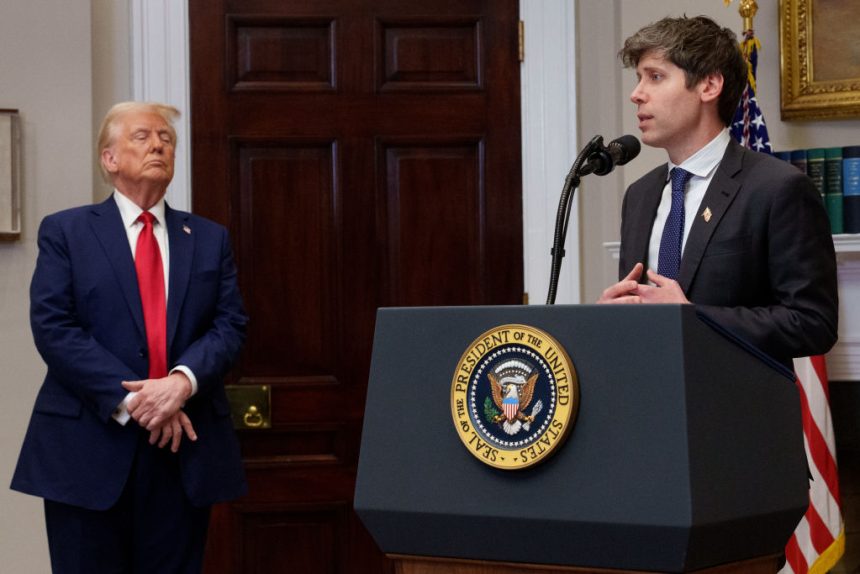
Sam Altman has never shied away from big, boundary-pushing ideas, and his latest one has nothing to do with a faster model or a slicker chatbot. According to a report from the Financial Times, the OpenAI chief executive has proposed handing over 5% of the company’s equity to a U.S. sovereign wealth fund — a move that would, in theory, let ordinary Americans share directly in the financial windfall of the artificial intelligence surge.
It’s an unusual pitch coming from one of the most valuable private companies on the planet. Sovereign wealth funds are typically stocked with oil revenues or trade surpluses, not stakes in Silicon Valley startups. The idea of routing a piece of OpenAI into a public investment vehicle reframes a familiar debate: who actually profits when AI reshapes entire industries, and whether the gains should flow beyond a small circle of investors and employees.
The proposal, at this stage, is exactly that — a proposal. The talks remain preliminary, and nothing has been finalized. There is no signed agreement, no legal framework laid out, and no confirmation from the government side about whether it would even entertain the notion. In other words, this is a trial balloon rather than a done deal.
Still, the symbolism is hard to ignore. Altman has spent years arguing publicly that the wealth generated by advanced AI could be so enormous — and so concentrated — that societies will need new mechanisms to spread it around. He has previously mused about universal basic income and other redistribution schemes. Donating equity to a national fund is a more concrete version of that same instinct: instead of taxing profits after the fact, you build public ownership into the structure from the start.
There are obvious questions the plan doesn’t yet answer. How would the fund be governed? Would the public stake come with voting rights or purely financial upside? And what happens to that 5% if OpenAI’s valuation swings wildly, as fast-moving tech valuations tend to do? A stake in a company whose worth is still being furiously debated is a very different thing from a dividend-paying blue chip.
For readers who follow the gadgets and services that OpenAI actually ships, this is a reminder that the company’s ambitions stretch well past product launches. The tools coming out of its labs are increasingly woven into phones, laptops, cameras and creative software — and Altman is clearly thinking about the economic aftershocks as much as the features.
Whether a sovereign wealth fund ends up holding a piece of OpenAI or not, the conversation itself is telling. The industry building the technology now openly acknowledges that its rewards may be too big to keep entirely to itself. What comes next depends on whether that acknowledgment turns into policy — or stays a headline.