Midjourney made its name conjuring pixels out of text prompts. Now it wants to conjure a picture of your insides — using sound, water and a tank that looks suspiciously like a spa hot tub.
The company has offered a fresh look at its Fullbody Ultrasonic Computational Tomography scanner, mercifully shortened to Ultrasonic CT. The material comes courtesy of a nearly 20-minute behind-the-scenes video from tech YouTuber Marcin Plaza, who — as it happens — also works as an engineer at the company. His candor is refreshing: he describes the machine as scores of ultrasound probes “hacked apart and slapped on a glorified hot tub with an elevator in it,” wired up to off-the-shelf computers and Raspberry Pi boards.
The pitch is ambitious. Midjourney claims the device can produce a detailed body scan in 60 seconds, relying entirely on sound waves and water. Crucially, there’s no radiation and no magnetic fields involved — a genuinely appealing proposition compared with CT or MRI, if it delivers on the promise.
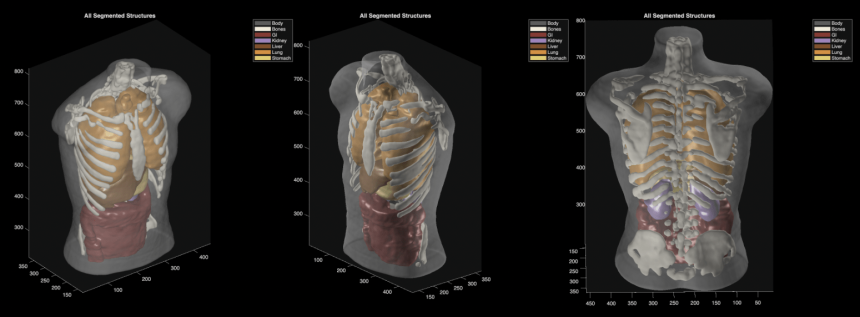
That “if” is doing a lot of heavy lifting. This is a first-generation prototype with no regulatory clearance, and the demonstration still offers little hard proof that it works reliably. One of the released images shows a scan of an imaging phantom — a test object used to validate how cleanly anatomical structures separate under controlled conditions. It’s a reasonable engineering milestone, but a phantom is not a patient.
Midjourney is being careful about how it frames the launch, and for good reason. Rather than promising diagnosis, the company plans to open with body-composition maps — think fat, muscle and fluid distribution rather than spotting tumors. That distinction matters enormously from a regulatory standpoint, and it neatly sidesteps the medical-device approvals that a diagnostic tool would demand.
The rollout plan reads more like a wellness venture than a hospital deployment. Midjourney intends to house the scanners in a spa, with the first location slated for San Francisco in late 2027. Over the coming 12 months, the company says it will fine-tune both its algorithms and the hardware, run research trials, and develop a second-generation design.
It’s a wild leap for a startup best known for generating dreamy AI artwork, and skeptics have plenty of ammunition. Reconstructing accurate 3D anatomy from ultrasound is fiendishly hard, and cobbling together dismantled probes on a tub full of water is a long way from a validated imaging platform.
Still, the underlying idea — cheap, fast, radiation-free imaging — is exactly the kind of moonshot the medical world could use. Whether Midjourney can turn a glorified hot tub into a serious scanner, or whether this ends up as a very expensive spa gimmick, remains to be seen. For now, the questions considerably outnumber the answers.