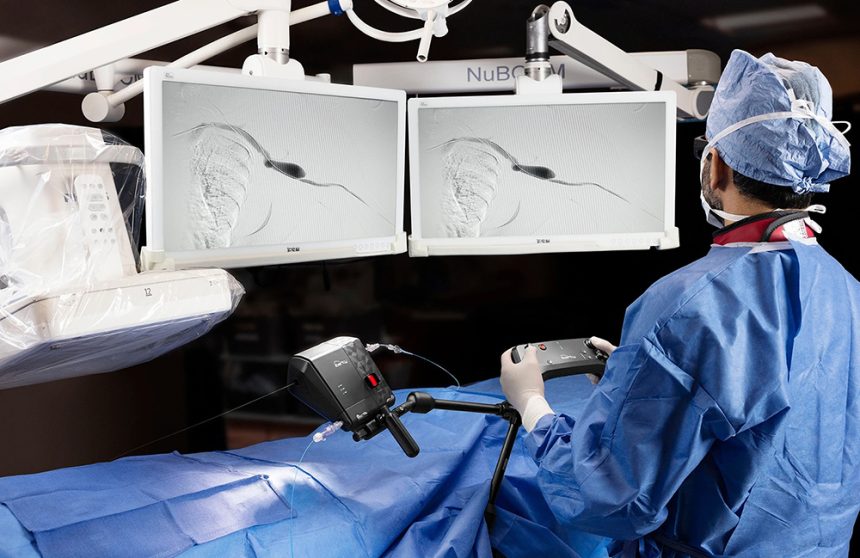
Robotic surgery is finally reaching the people who often need it most — and can least afford the wait. Microbot Medical has lined up a channel to funnel its LIBERTY® Endovascular Robotic System into U.S. federal healthcare programs, opening the door for military veterans to benefit from remotely operated vascular procedures.
The mechanics of the deal are refreshingly straightforward. Lovell Government Services, a service-disabled veteran-owned small business, will act as Microbot’s federal vendor. That designation matters: it gives the company a compliant route onto the government supply schedule that serves the Department of Veterans Affairs and other federal agencies. Activation of that access is expected in Q3 2026.
So what exactly are veterans getting? LIBERTY is an FDA-cleared, single-use, remotely operated robotic system built for peripheral endovascular procedures. Instead of a surgeon standing at the table hand-feeding guidewires and catheters through a patient’s vasculature, LIBERTY handles the remote delivery and manipulation of those tools — plus remote manipulation of guide catheters — to steer precisely toward anatomical targets in the peripheral vessels.
The payoff is twofold. First, precision: fine, controlled navigation through tortuous vasculature is exactly the kind of task where steady robotic actuation beats a fatigued human wrist. Second, and arguably more important for the clinical staff, is protection. Endovascular work is guided by fluoroscopy, meaning the operators are typically bathed in X-ray radiation for hours while wearing heavy lead aprons that grind down their spines over a career. By letting the physician work remotely, LIBERTY is designed to reduce both radiation exposure and physical strain — a genuine occupational-health win, not just a marketing line.
The single-use design is a notable choice, too. It sidesteps the reprocessing and sterilization headaches that dog reusable robotic instruments, which is precisely the kind of predictability large institutional buyers like the VA tend to appreciate.
The timing lines up neatly with Microbot’s broader push. The system reached full market release in April 2026, when it officially launched at the Society of Interventional Radiology Annual Scientific Meeting 2026. Getting it onto a federal supply schedule so soon after that debut suggests Microbot is moving aggressively to plant its flag in large, stable institutional markets before rivals crowd the space.
Pricing hasn’t been publicly disclosed, which is standard for capital-equipment medical robotics sold through negotiated institutional contracts rather than off a shelf. For veterans, of course, the sticker isn’t really the point — access is. And that’s what this arrangement is engineered to deliver.
It’s an unglamorous piece of business plumbing, but a meaningful one. Getting cutting-edge robotic surgery approved is one thing; getting it into the operating rooms that treat former service members is another entirely.