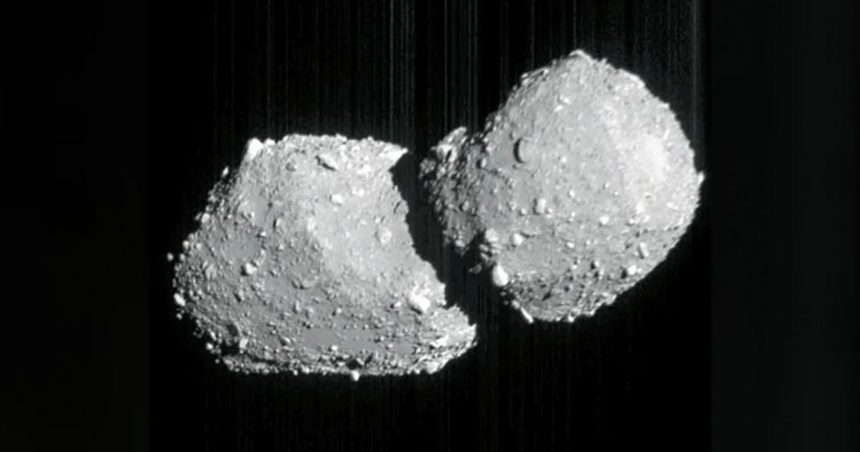
Japan’s Hayabusa2 probe has done it again. On July 5 at 6:30 p.m. Japan Standard Time, the spacecraft threaded a high-speed pass within roughly six miles (10 kilometers) of Torifune, a 1,475-foot (450-meter) asteroid tumbling through space some 62 million miles (100 million kilometers) from Earth. The result is a strikingly clear image of what looks like a two-headed rock — a lumpy, peanut-shaped body about the length of the Empire State Building.
The Japan Aerospace Exploration Agency (JAXA) captured Torifune using two of the probe’s onboard instruments: the Optical Navigation Camera–Telescopic (ONC-T) for the visible-light shot, and the Thermal InfraRed Imager (TIR) for its heat signature. Both instruments kept working right up to the moment of closest approach.
A one-shot window
Timing was everything here. As JAXA explained, the observations “continued until immediately before the closest approach to Torifune but could not be conducted after the spacecraft had passed the asteroid.” There was no second try. What’s more, only part of the science data has made it back to Earth so far — the rest will trickle down during future operations. The agency also flagged the encounter as a “risky operation,” since the team couldn’t be sure what conditions awaited around the rock.
What we know about Torifune
Torifune is a near-Earth asteroid that crosses our planet’s orbit, circling the Sun once every 383 days and spinning on its axis every five hours. Its surface is rocky and weathered, made up mostly of the silicate minerals pyroxene and olivine — the kind of ancient material that helps scientists piece together the early Solar System.
The probe that keeps giving
Hayabusa2 is no newcomer. Back in 2018 it landed on the asteroid Ryugu, scooped up 5.4 grams of material, and dropped the precious sample into the Australian desert for recovery. That haul turned out to be extraordinary: researchers found all five nucleobases present in DNA and RNA locked inside the Ryugu grains.
The reason Hayabusa2 is still roaming years later comes down to fuel economy. Its efficient propulsion system left it with nearly half its original xenon propellant at the end of the Ryugu mission — roughly 30 kg remaining of the 66 kg it launched with. That surplus gave JAXA the room to plan two more asteroid rendezvous.
- Instruments used: ONC-T optical camera and TIR thermal imager
- Closest approach: about six miles (10 kilometers)
- Next target: asteroid 1998 KY26
That next stop is a big change of scale. 1998 KY26 measures just 36 feet (11 meters) across, and Hayabusa2 is hoping to land on it. By studying such a tiny body, JAXA wants to learn how these miniature asteroids are structured — the kind of detail that could matter enormously if one ever heads our way.