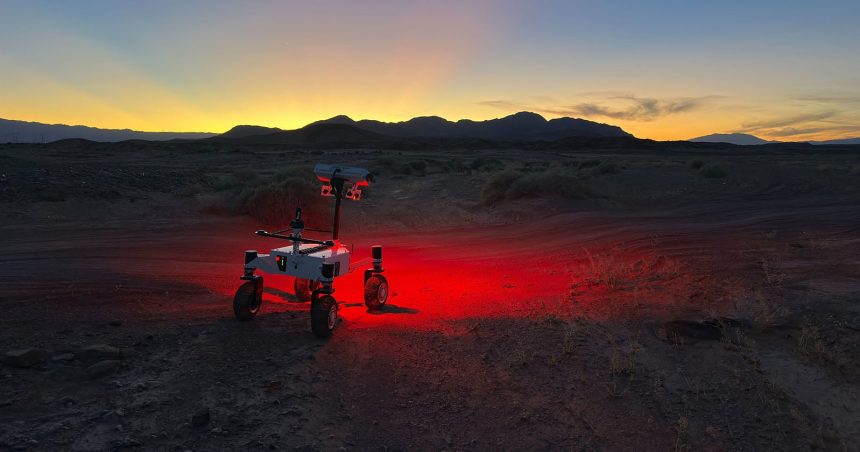
NASA’s next off-world rover just proved it can handle a road trip. In March 2026, engineers from the Jet Propulsion Laboratory drove a prototype called ERNEST across the Colorado Desert in Southern California, and the machine covered roughly 16 miles (26 kilometers) with only minimal input from the team on the ground.
The acronym stands for Exploration Rover for Navigating Extreme Sloped Terrain, and it hints at exactly what this vehicle is meant to do — go where NASA’s current Mars veterans, Perseverance and Curiosity, would get stuck. Those two are six-wheeled workhorses. ERNEST takes a different approach with just four wheels, each of which can be lifted independently to clamber over obstacles that would stymie the older rovers. In this design, fewer wheels turn out to be a feature rather than a compromise.
At four feet (1.2 meters) long, ERNEST is a compact machine, but the headline here is stamina and autonomy. That 16-mile desert crossing took 37 hours, and while that may sound leisurely, NASA points out the new rover moves “orders of magnitude” faster than the rovers currently working on the Red Planet. It tops out at around 0.6 mph (1 kph) — glacial by earthbound standards, but a genuine leap for planetary exploration.
The JPL team ran ERNEST at every time of day during the seven-day campaign, including dusk, dawn and full night. Engineers even hauled in illuminators for pre-sunrise runs, deliberately courting the long shadows and awkward lighting the rover would face off-world. “This testing is helping us refine the mobility hardware and autonomy software to navigate extreme distances across a wide range of terrain and lighting conditions anticipated on the Moon,” said Issa Nesnas, a principal technologist at JPL who led the field test.
That mention of the Moon is the other twist. Unlike Perseverance and Curiosity, ERNEST isn’t being groomed solely for Mars. It could just as easily end up rolling across the lunar surface. “You could do a science road trip across the Moon — or Mars — with this vehicle,” said James Keane, a JPL planetary scientist working on lunar missions.
ERNEST has been in development since 2022, moving through a long parade of designs, virtual simulations and prototypes before finally being turned loose in real dirt. The desert campaign marks a major graduation from the lab to the field, even if a launch remains years away.
For now, ERNEST is still very much a prototype — no crew, no rocket, no confirmed destination. But the early results are promising enough that the next great discovery on the Moon or Mars may well arrive on four independently articulating wheels.