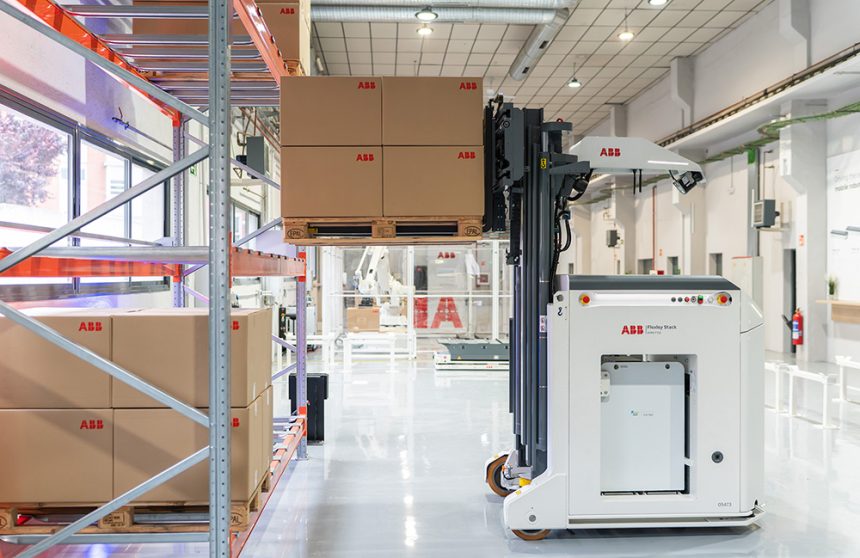
Warehouse automation just lost one of its most annoying prerequisites: infrastructure. ABB Robotics unveiled the Flexley Stack F712 on July 7, 2026, an autonomous forklift that navigates purely by vision, no floor markers, reflectors or magnetic strips required.
The trick is Visual SLAM (vSLAM), a technique that lets the machine build a map of its surroundings and locate itself within it in real time, using cameras rather than pre-installed guides. In practice, that means you can drop the F712 into an existing facility without ripping up floors or dotting the ceiling with markers. It reads the environment the way a human operator would, then plots its own path.
Underneath the clever navigation is a genuinely capable industrial machine. The F712 handles loads of up to 2,000 kg and reaches shelving heights of 8.5 meters, putting it in serious pallet-stacking territory rather than the lightweight-tote category. It moves at up to 1.7 m/s while loaded, which is brisk for something carrying two tonnes, and it places pallets with a positional accuracy of ±10 mm. That tolerance matters when you’re slotting a load into a high rack with no room for error.
Because vSLAM doesn’t lean on fixed reference points, the F712 adapts when the warehouse changes around it, new aisles, shifted racking, seasonal layouts. That flexibility is precisely the pitch: fewer sunk costs in infrastructure, faster deployment, and a robot that keeps working when the floor plan doesn’t stay still.
ABB also built the F712 to play nicely with a mixed fleet. It’s designed to operate alongside other robots, so it can slot into an automated ecosystem rather than demand a dedicated lane of its own. For operators running a patchwork of AMRs and automated equipment, that interoperability is often the difference between a pilot project and a rollout.
Safety is the other half of the equation, and ABB says the F712 is certified to ISO and ANSI safety standards, the credentials any facility manager will want before letting an autonomous two-tonne machine share space with people.
A few things ABB hasn’t spelled out yet: pricing isn’t public, and there’s no confirmed availability date for ordering. Given the heavy lifting involved, expect the F712 to be quoted per deployment rather than carrying a shelf price. What’s clear is the direction of travel, high-payload autonomy that installs like software rather than construction, and the F712 is ABB’s bid to make that the default.