Programming an industrial robot has long been the domain of specialists fluent in proprietary teach pendants and cryptic motion commands. A new global agreement between ENCY Software and Stäubli Robotics aims to knock down that barrier, and the goal is refreshingly clear: make robot programming faster, more intuitive, and open to more people.
The deal, announced on July 7, 2026, pairs Stäubli’s high-performance industrial arms with Ency Robot, ENCY Software’s CAD/CAM-based platform for offline programming, simulation, and trajectory generation. The two were formally introduced at the Ency World Conference 2026 in June, and the partnership now extends that alliance worldwide.
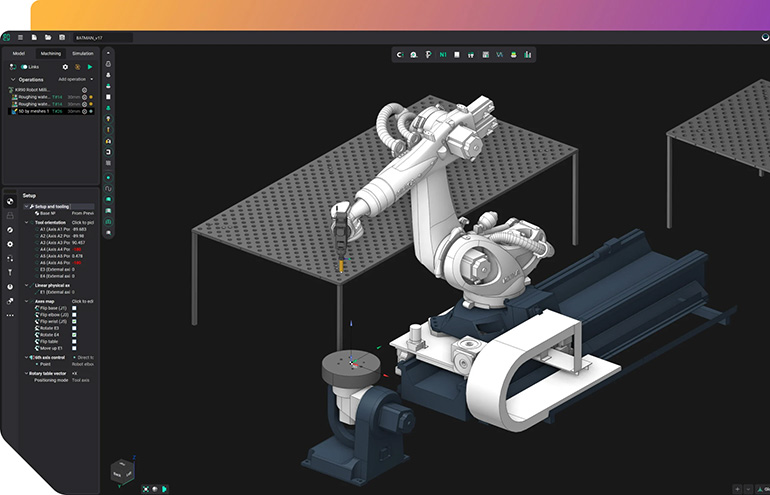
The technical heart of the collaboration is translation. Anyone who has tried to move from a slick CAD model to a real robot process knows the pain: complex geometry rarely maps cleanly onto physical motion. Ency Robot handles that leg of the journey, converting intricate CAD/CAM trajectories into reliable, controllable robot paths that a Stäubli machine can actually execute on the shop floor.
That matters most in process-heavy manufacturing, where the tool never stops touching the workpiece. The partnership specifically targets applications such as:
- Milling
- Grinding
- Cutting
- Deburring
- Polishing
- Laser processing
These are exactly the jobs where a fumbled trajectory means a ruined part, a chipped tool, or a scrapped batch. By doing the heavy lifting offline — planning and simulating the path before the robot ever powers up — manufacturers can validate a process virtually, catch collisions and singularities in software, and hit the ground running when the arm goes live.
The offline-programming approach also chips away at one of automation’s quieter costs: downtime. Traditional teach-and-repeat programming often ties up the robot and the line while an operator jogs the arm point by point. Generating and testing trajectories in a simulated environment keeps the physical hardware productive and shortens the gap between design intent and finished product.
There’s a strategic logic here too. Stäubli brings the mechanical precision and reliability that its robots are known for; ENCY brings a software layer that speaks the language engineers already use — CAD and CAM — rather than forcing them to learn a robot’s dialect. It’s a familiar pattern in modern automation, where the arm is increasingly a commodity and the intelligence lives in the toolchain that drives it.
For manufacturers weighing whether to automate a delicate finishing or machining task, the pitch is straightforward: the same digital model you designed in can carry all the way through to a moving robot, with fewer hands and less trial-and-error in between. Whether the combined workflow lives up to that promise on real factory floors will be the true test — but the direction of travel, toward accessible, CAD-driven robotics, is unmistakable.