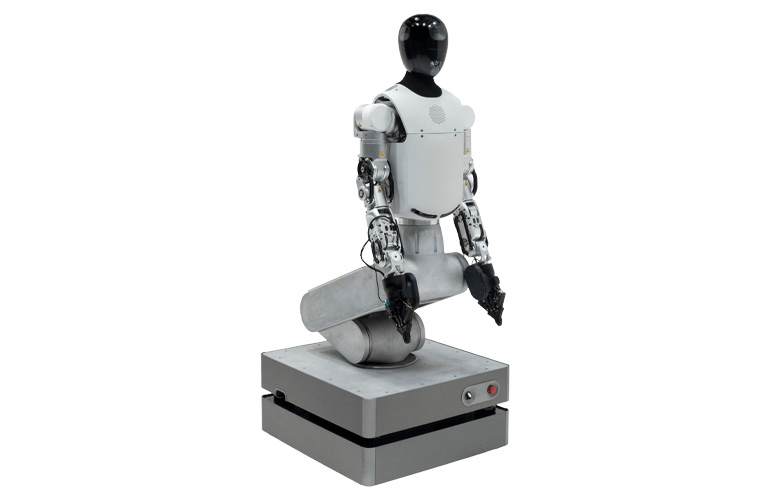
A UK startup barely two years old just convinced investors it’s worth $1.35 billion. Humanoid — founded in 2024 as SKL Robotics Ltd. — closed a $152M Series A round on July 21, 2026, and the money is aimed squarely at pushing its industrial robots out of the lab and onto factory floors.
The headline machine is the HMND 01 Alpha, and its spec sheet reads like a serious attempt at real-world usefulness rather than a viral demo reel. It carries a 15 kg payload, runs for up to four hours on a charge, and moves through 29 degrees of freedom — enough articulation to handle the awkward, repetitive tasks that industrial employers struggle to staff.
What’s arguably more interesting than the mechanics is the brain. Humanoid’s proprietary AI platform, KinetIQ, ties together perception, reasoning and motion control so the robot can operate autonomously in industrial settings rather than following a rigid, pre-scripted routine. That’s the difference between a robot that repeats one motion forever and one that can adapt to a cluttered, unpredictable warehouse.
Not every unit walks, either. Humanoid’s key machines are wheeled robots, though a bipedal variant exists too — a pragmatic nod to the fact that in many industrial environments, wheels are simply faster, more stable and cheaper to keep upright than legs.
Speaking of cost: the HMND 01 Alpha Bipedal variant is priced at US$120,000. That’s steep for a single machine, but it puts Humanoid in the same conversation as the handful of well-funded rivals trying to turn general-purpose robots into a line item on corporate procurement sheets.
There’s an important caveat, though, and Humanoid isn’t hiding it. As of now, no commercial units have shipped. Beta versions of the robots are scheduled to begin deployment in Q4 2026, meaning the first real-world trials are still ahead. The Series A cash is explicitly earmarked to scale production and expand those commercial deployments — the classic capital-intensive push every hardware company faces between a promising prototype and a shipping product.
The valuation is the eye-catching number, but it also raises the stakes. A $1.35 billion price tag for a company that hasn’t yet delivered a paying customer’s robot is a bet on execution, not track record. Humanoid now has to prove that KinetIQ works outside controlled demos, that a $120,000 robot earns its keep, and that beta hardware can graduate to dependable commercial units.
If the Q4 2026 beta rollout goes smoothly, Humanoid could become one of the first British names to matter in a field currently dominated by American and Chinese players. If it slips, the gap between valuation and reality gets uncomfortable fast. Either way, the next two quarters will tell us a great deal.