High above Sudan, a war almost nobody is watching plays out in the sky. Turkish-built heavy drones are hunting Chinese-made UAVs in a mechanized duel for air superiority, and while machines trade blows overhead, civilian casualties on the ground keep climbing sharply.
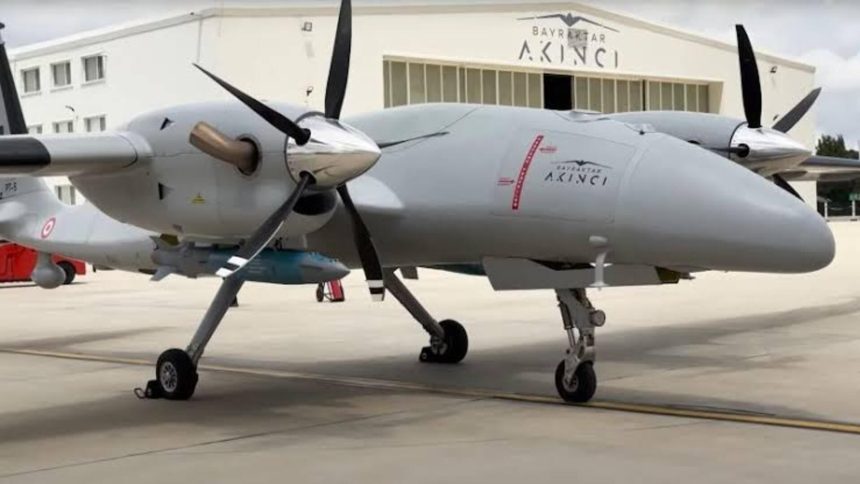
At the center of this contest sits the Bayraktar Akinci, the flagship unmanned aircraft from Turkish defence firm Baykar. Calling it a “drone” almost undersells the thing. With a wingspan of roughly 20 meters — about 66 feet — the Akinci is closer in scale to a manned combat aircraft than to the palm-sized quadcopters most people picture. It is one of the largest armed UAVs anywhere in operational service.
The numbers explain why it dominates. The Akinci carries a maximum takeoff weight of around 6,000 kilograms and hauls a payload of up to 1,350 kilograms of sensors and munitions. It can loiter for more than 24 hours and climb to a service ceiling of about 13,700 meters — high enough to watch, wait, and strike long after lighter systems have run out of fuel.
Under the hood, Baykar offers several engine configurations:
- Akinci A — two 450 horsepower Ukrainian turboprop engines
- Akinci B — two 1,500 horsepower engines
- Akinci C — two 850 horsepower engines, for 1,700 HP total
That kind of firepower doesn’t come cheap. Recent government purchases put the Akinci at an estimated US$8 million per unit, though some sources report per-unit costs exceeding US$100 million once you factor out — rather than in — munitions and long-term maintenance. Either way, it’s an expensive way to contest the skies, and it’s now facing off against equally pricey million-dollar Chinese UAVs over Sudan.
The platform has a track record. The Akinci made its maiden flight on December 6, 2019, and the first three units entered service with the Turkish Armed Forces on August 29, 2021. It remains in active operational service today, and its export success has spread it across multiple conflict zones — Sudan being the latest, and one of the least reported.
What makes this fight notable isn’t just the hardware, but what it represents. Two industrial drone programs — one Turkish, one Chinese — are effectively field-testing their technology against each other in a live war. Endurance, payload, altitude and sensor packages that read like spec-sheet bragging rights on a trade-show stand are being decided in real time over a country most headlines have quietly moved past.
For a machine designed to stay airborne for over a day, the Akinci’s most unsettling feature may be exactly that: patience. It can watch, and it can wait. And in Sudan, the people beneath it are paying the price of a technological rivalry playing out far above their heads.