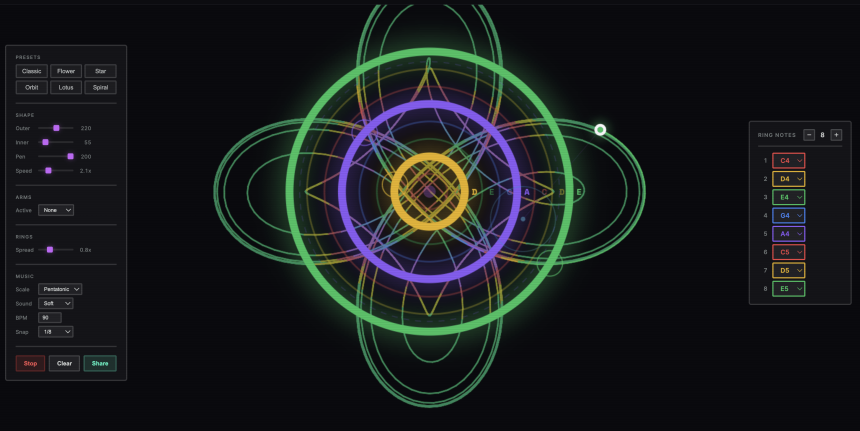
Anyone who owned a Spirograph as a kid knows the quiet trance of watching a pen trace endless loops through a plastic gear. Musical Spirograph takes that same hypnotic geometry and drops it straight into a browser tab — then hands it a soundtrack.
The idea is deceptively simple. A set of points scurries across the screen following mathematical rules, drawing the same family of curves the physical toy always produced: hypotrochoids and epitrochoids. As those points sweep around, they cross a series of concentric rings, and each crossing fires off a specific note. The result is a generative composition that emerges from the drawing itself, rather than being layered on top of it. The visuals aren’t decoration for the music — they are the music.
What keeps it from being a one-note gimmick is how much you can tinker. You get six different virtual rotors to choose from, each producing its own flavor of pattern, and you can run up to three arms drawing at once. Stack those variables together and the number of visual-and-sonic combinations climbs quickly, so no two sessions really sound or look the same.
Part of the appeal is that there’s no learning curve to speak of. You don’t need to understand parametric equations or read music to get something pleasant out of it — you nudge a few settings, watch the rings light up, and the tool does the composing. It sits in that sweet spot between a toy, a screensaver and an ambient instrument, which makes it dangerously easy to leave open in a background tab.
- Curves generated: hypotrochoids and epitrochoids, drawn by points following mathematical equations
- Sound engine: notes triggered as points pass through concentric rings
- Rotors: six virtual rotors to pick from
- Arms: up to three drawing simultaneously
- Platform: runs entirely in the browser
There’s a long lineage of generative music toys that live in the browser, and most of them lean either too far into the abstract or too far into the novelty. Musical Spirograph works because it borrows an object people already have a nostalgic relationship with, then quietly explains the math-to-melody connection by making it visible in real time. You can literally watch the note being born.
It’s the kind of thing that rewards a few minutes of idle poking and occasionally produces something genuinely lovely by accident. Whether you’re chasing a calming visual, experimenting with generative composition, or just reliving a bit of analog childhood in digital form, it’s a satisfying little rabbit hole — and one that costs you nothing but a browser tab and some free time.