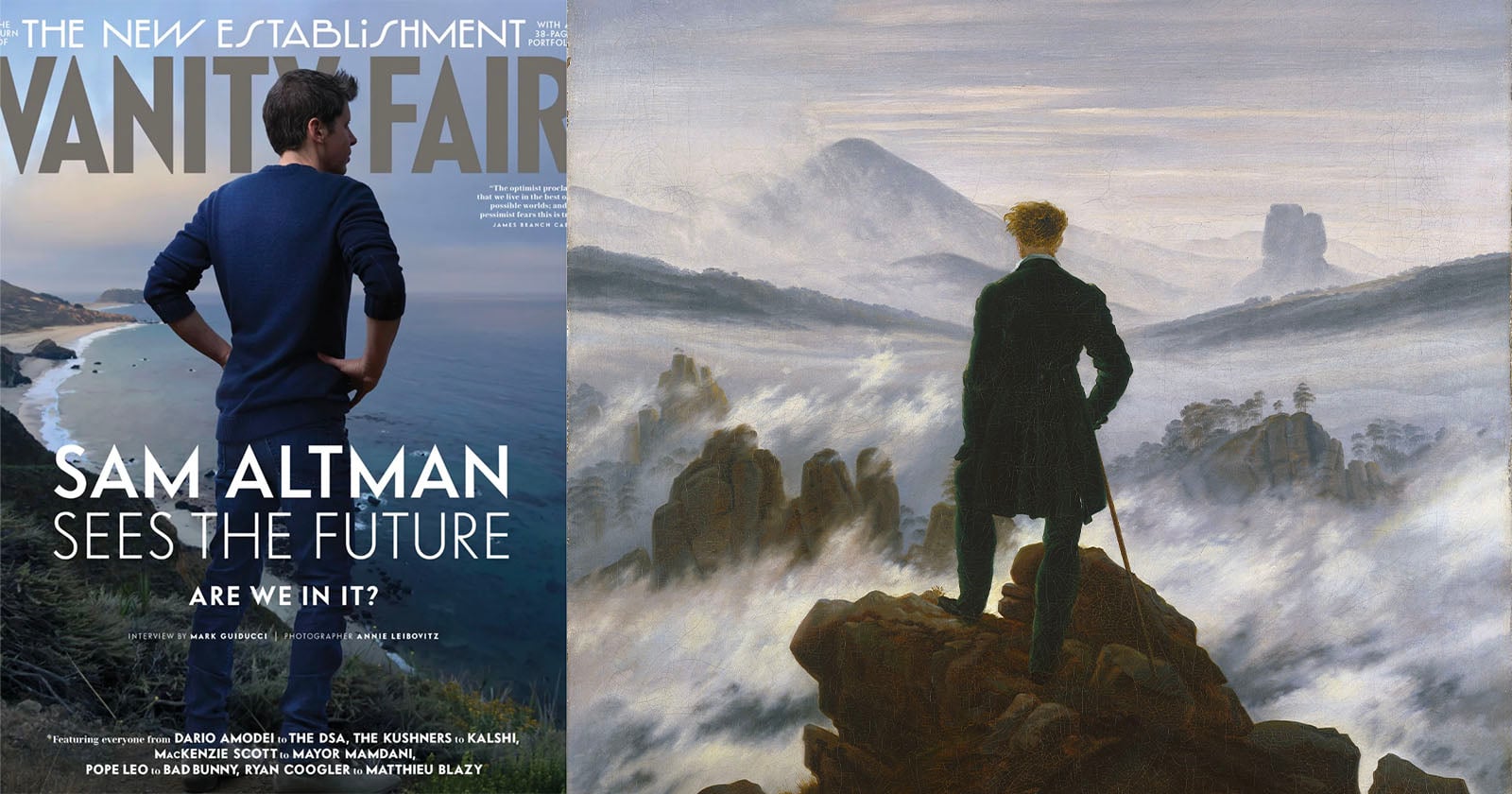
Annie Leibovitz has never been shy about borrowing from art history, and her portrait of OpenAI CEO Sam Altman for Vanity Fair goes straight to one of the most recognisable images of 19th-century painting. The cover, made for the magazine’s revived New Establishment issue, takes its cue from German Romanticism and, specifically, from Caspar David Friedrich’s Wanderer above the Sea of Fog.
The cover image began circulating on October 5, 2026. It shows Altman beneath the headline “Sam Altman Sees the Future” and the question “Are We In It?”, with the interview credited to editorial director Mark Guiducci and the photography to Leibovitz. For the shoot, Leibovitz visited Altman in Big Sur, on the California coast, while Guiducci interviewed him twice in a studio near OpenAI’s headquarters in San Francisco.
Why Friedrich fits
Friedrich’s canvas, dated c. 1818 and held by the Hamburger Kunsthalle in Hamburg since 1970, shows a man in a dark green overcoat standing on a rocky precipice with his back to the viewer, gazing over a thick sea of fog. The landscape was drawn from the Elbe Sandstone Mountains in Saxony and Bohemia and rearranged by the painter in the studio. The figure is a Rückenfigur (a rear-facing figure), a device Friedrich used often, and this one is widely called the most famous example of it in art.
The trick of the Rückenfigur is that we do not see the subject’s face; we see what he sees, or rather what he cannot yet see through the fog. For a cover line that literally asks whether readers are in the future Altman sees, that ambiguity does a lot of the editorial work. Swapping Saxon sandstone for a Pacific coastline keeps the mood while moving the scene to the doorstep of Silicon Valley.
The list behind the cover
The New Establishment returned after nearly a decade, and in his editor’s letter dated October 5, 2026, Guiducci put AI first among the subjects of the revived feature, alongside changes in money and the relationship between politics and business. The 2026 ranking, which the magazine says measures “real power” rather than wealth or follower counts, placed:
- 1. Sam Altman, OpenAI CEO
- 2. Dario Amodei, Anthropic CEO
- 3. Elon Musk
- 4. Jensen Huang, Nvidia CEO
Others in the top ten included Kevin Warsh, JD Vance, Marco Rubio, Sundar Pichai, Ted Sarandos and Neal Mohan. Vanity Fair tied Altman’s position to the launch of ChatGPT and the rapid growth of AI, suggesting he may one day be seen as “the Oppenheimer of our time.”
What Altman said
The interview ranged over extinction risk, Elon Musk and a film in which Andrew Garfield plays Altman. Asked whether he was considering a presidential run, Altman answered “No,” adding: “I do not ever plan to run for office.” He called reports that he had looked at running for governor of California true, explaining the decision with “I think AI is way more important.”
For photographers, the takeaway is the method rather than the celebrity. Leibovitz built a portrait of a tech CEO on a two-century-old visual idea, letting a single borrowed composition carry the story’s central question about the future.