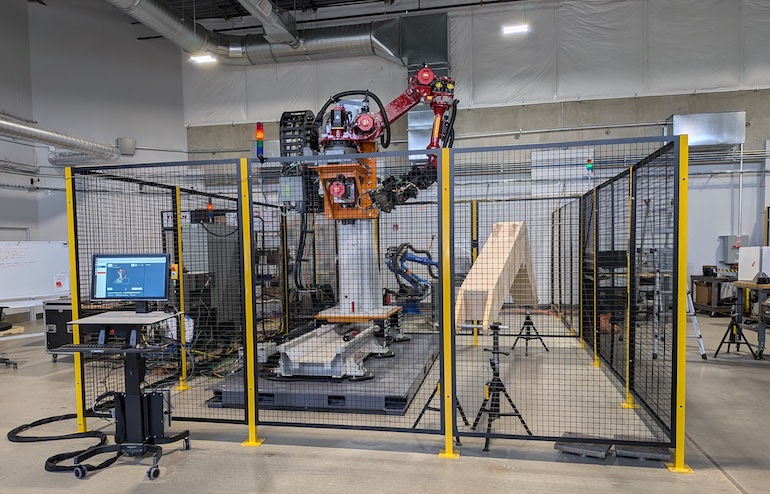
Industrial grinding has long had a stubborn limitation: bolt a robot to the floor, and its reach is only as good as its arm. Güdel wants to break that boundary, and at Automate 2026 in Chicago the Swiss-American motion specialist showed exactly how — by giving heavy-duty grinding cells two extra degrees of freedom.
The trick lies in two systems working in tandem: TrackMotion Vertical (TMV) and TrackMotion Floor (TMF). Together they free a robot from its fixed pedestal, letting it travel along the shop floor and rise to meet work that sits well above arm height.
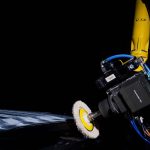
The centerpiece of the demonstration was a FANUC R-1000 robot fitted with a grinding end-of-arm tool. Rather than standing in one spot, the robot was mounted on a TMV unit, which in turn rode along a TMF track. The result is a grinding cell that can slide horizontally and lift vertically — chasing seams, welds and surfaces across a large part instead of waiting for the part to be repositioned.
Two numbers tell the story. Combined with the TMF, the setup delivers a lifting height of roughly 3 m, opening up tall castings and oversized fabrications to automated finishing. And the TrackMotion Floor isn’t shy about payload: it can move robots weighing up to six tons, which is exactly the kind of muscle heavy grinding work demands.
Why does this matter? Grinding is one of the dirtiest, most physically punishing jobs on any production floor, full of vibration, dust and tedium. Automating it is attractive — but a stationary arm simply can’t cover the geometry of large industrial parts. By turning the robot into something that moves on two axes of its own, Güdel effectively scales up the working envelope without scaling up the robot itself.
It’s a neat piece of mechanical thinking. Instead of buying a bigger, heavier, longer-reach robot, integrators can pair a capable mid-size arm like the R-1000 with motion infrastructure beneath and behind it. The robot does the precise work; the TMV and TMF handle the heavy lifting and the legwork.
The systems come from Güdel Inc., the U.S. subsidiary of the Güdel Group, headquartered in Langenthal, Switzerland — a company that has built its reputation on linear motion, gantries and track systems for exactly this kind of large-format automation.
This is firmly B2B territory, not something destined for a consumer workshop. But for manufacturers wrestling with the grind of finishing big metal components, the message from Automate 2026 was clear: the robot no longer has to stand still.