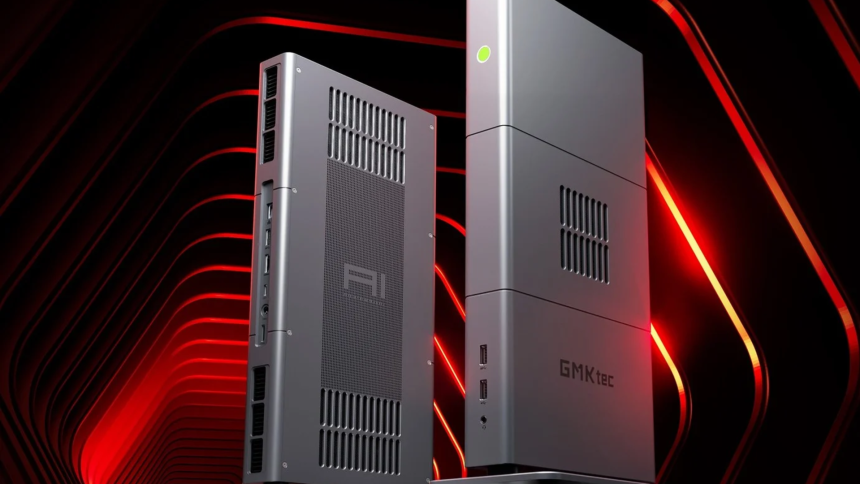
Forget the palm-sized boxes we usually associate with the term. The GMKtec EVO-X3 is a mini PC only on paper — in the flesh it’s a tall, triple-fan tower wrapped in steel that looks far more like a beefy graphics card than a desktop appliance. And that’s exactly the point: GMKtec redesigned its Strix Halo workstation around one obsession, cooling, so it can run local AI models without gasping for air.
At the heart sits AMD’s Ryzen AI Max+ 395 ‘Strix Halo’ processor, the same chip you’ll find in a growing crop of AI-focused workstations. It fuses CPU, GPU and a hefty NPU into a single package, with the neural engine rated at 50 TOPS. That comfortably clears the 40 TOPS bar Microsoft demands for its Copilot+ badge, leaving some headroom for the round-the-clock inference GMKtec is chasing.
Where the EVO-X3 really flexes is memory. Both configurations ship with 128 GB of LPDDR5X-8000 — a serious allocation that matters enormously when you’re loading large language models into local memory rather than shuttling them off to the cloud. More RAM means bigger models and longer context windows without hitting a wall.
Storage is the only place the two versions diverge:
- US$3,600 — 128 GB memory, 2 TB storage
- US$3,849 — 128 GB memory, 4 TB storage
To make all that silicon actually useful out of the box, GMKtec bundles its proprietary Claw+Wrangler suite — a local-inference toolkit built for one-click setup and always-on AI agents. The idea is to skip the usual weekend of dependency-wrangling and get you running local agents that keep working while you sleep, with your data staying on your own machine rather than someone else’s server.
That software focus explains the hardware silhouette. Cramming a 50 TOPS NPU, a capable integrated GPU and 128 GB of fast memory into a small footprint generates heat, and heat throttles inference. GMKtec’s answer is that skyscraper chassis and its trio of fans — a steel-clad tower engineered to keep the Strix Halo silicon at full tilt during sustained AI workloads, not just brief bursts.
Early access registration opened on June 22, with the global launch and shipping both set for July 6. At US$3,600 to start, the EVO-X3 isn’t an impulse buy, but for anyone serious about running AI models entirely on their own desk — no subscriptions, no data leaving the room — the combination of Strix Halo, 128 GB of memory and a genuinely over-built cooling system makes a compelling case.