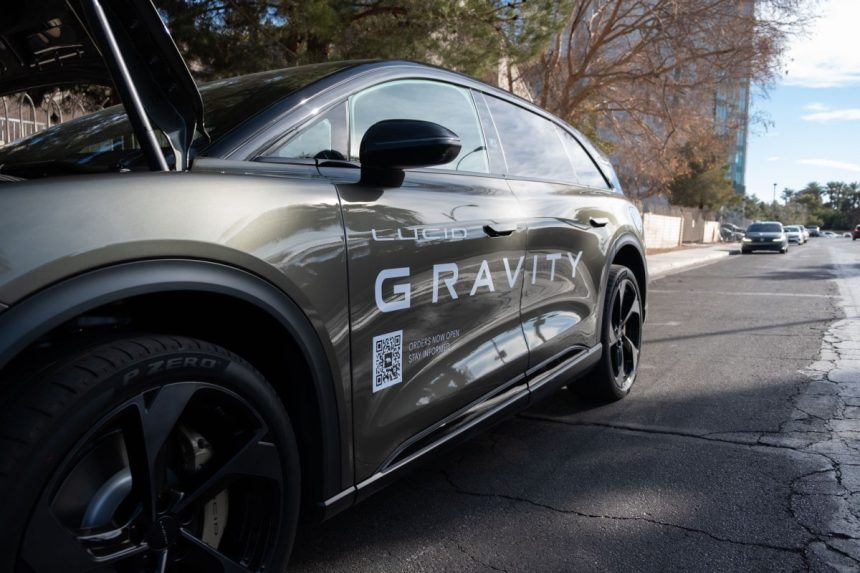
Lucid’s grand reset reads like a company confessing its sins in public — and one of its four “must win” bets is a self-driving version of the Gravity SUV built exclusively for Uber. It’s the part of Lucid’s turnaround story that actually sounds like the future, rather than a spreadsheet.
The vehicle, unveiled at CES 2026, is a curious three-way collaboration: Lucid builds the car, Nuro supplies the autonomous driving stack, and Uber operates the premium ride-hailing service. Passengers hail one through the Uber app, climb in, and — crucially — nobody is sitting up front to judge their music taste.
On paper it’s a genuinely spacious robotaxi. Lucid quotes comfortable seating for six passengers inside a cavernous cabin, with an estimated 450-mile range that should keep the fleet moving without constant charging pit stops. The autonomy hardware is a full sensor buffet — cameras, radars, lidar, ultrasound — feeding Nuro’s self-driving software running on Nvidia’s computing chips. This is not a lightly modified consumer car with a phone stuck to the windshield; it’s a purpose-built commercial platform.
A few important caveats. This is not a gadget you can buy. The robotaxi is a fleet vehicle owned and operated inside Uber’s commercial service, so there’s no retail price and no configurator. Nuro and Uber are currently testing a fleet of 100 vehicles in Houston and the San Francisco Bay Area, and Lucid began delivering production validation vehicles assembled at its facility in Coolidge, Arizona, last month.
Regular vehicle production is set to begin in the fourth quarter, with the launch expected in late 2026 — the near-term milestone Lucid is now leaning on heavily.
That reliance is telling, because the robotaxi program is one of the brighter spots in an otherwise grim ledger. New CEO Silvio Napoli, in unusually blunt fashion, said Lucid has “disappointed on several fronts, and for far too long,” citing missed commitments, products launched before they were ready, and quality issues met with sluggish responses. His broader “operational reset” targets $1.4 billion in cash savings, and the company reported a net loss of $1.26 billion against revenue of $405 million for the quarter.
Against that backdrop, the robotaxi looks less like a moonshot and more like a lifeline. Napoli projects margins “vastly exceeding those of the traditional retail model,” which is why Lucid spun up a new business unit — Lucid Technologies, led by chief digital officer Kai Stepper — to focus on AI, driver assistance, and digital technology.
Whether autonomous Gravity SUVs can outrun Lucid’s balance sheet is the open question. But of all the company’s promises, this is the one with hardware already rolling out of Arizona and a fleet logging real miles. For a company accused of shipping too early, it’s fitting that its most futuristic product is the one it’s being most careful about.