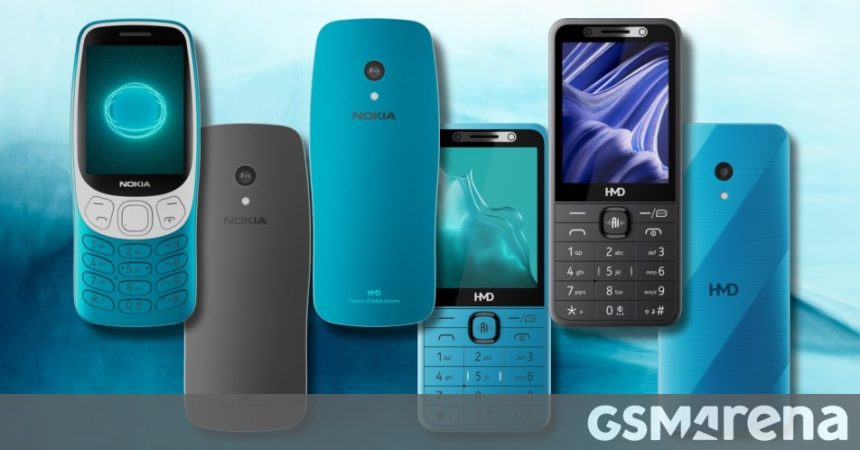
HMD has been living a double life. The company held a license to build Nokia-branded feature phones, a deal that was originally set to expire in 2026 before HMD secured a three-year extension. The catch: that extension appears to apply only to certain regions. Which is why we’re now seeing the same phones show up wearing two different badges.
An online retailer has listed the HMD 215 4G and HMD 235 4G, and they look effectively identical to the recently unveiled Nokia 215 4G (2026) and Nokia 235 4G (2026) — right down to the dedicated AI button. The only visible difference is the logo sitting beneath the display. Same hardware, different name on the front.
Both Nokia-branded versions — the Nokia 215 4G 2nd Edition and Nokia 235 4G 2nd Edition — were announced in July 2026. They share a familiar feature-phone recipe: a 2.8″ display, a 1450 mAh battery, 128 MB of storage and 64 MB of RAM. Neither is going to run your inbox, but that’s not the point.
The headline addition is that AI button. Press it and you summon Sikey AI, HMD’s on-device assistant — an unexpected feature for phones aimed squarely at the budget end of the market. The 235 4G goes a step further with a bundled Sikey AI chatbot and an Xpress Chat app, nudging the humble candybar toward something more conversational.
The two models differentiate themselves mostly on cameras. The 215 4G skips a rear shooter entirely and offers only a 0.3 MP front camera for video calls. The 235 4G adds a 2 MP rear camera alongside that same 0.3 MP front unit. Both keep the essentials feature-phone buyers actually use: 4G LTE, Bluetooth 5.0, USB Type-C charging and wireless FM radio.
On pricing, the Nokia versions carry an expected Indian tag of ₹3,299 for the 215 4G and ₹3,999 for the 235 4G. Whether the HMD-branded twins land at the same figures — or arrive in the regions where the Nokia license no longer applies — is the interesting question the retailer listing raises.
Rounding out the trio is the HMD 3210, announced in March 2025 and released the following April. It’s the odd one out here, built around a Unisoc T107 chipset, a smaller 2.4″ display, the same 1450 mAh battery, 128 MB of storage and 64 MB of RAM, plus a 2 MP rear camera. It launched at roughly $41.
The bigger story isn’t the specs — it’s the branding shuffle. HMD is quietly building a parallel lineup under its own name, hedging against the day the Nokia badge stops being an option. For now, buyers in some markets get to choose which logo they’d rather carry, even if the phone behind it is exactly the same.