Buying an industrial robot is a bit like buying a house you can’t visit first: the price tag is enormous, the commitment is long-term, and mistakes are painfully expensive. That’s the problem a digital twin is designed to solve — and, according to robotics software firm RoboDK, it can be a manufacturer’s best friend long before any capital changes hands.
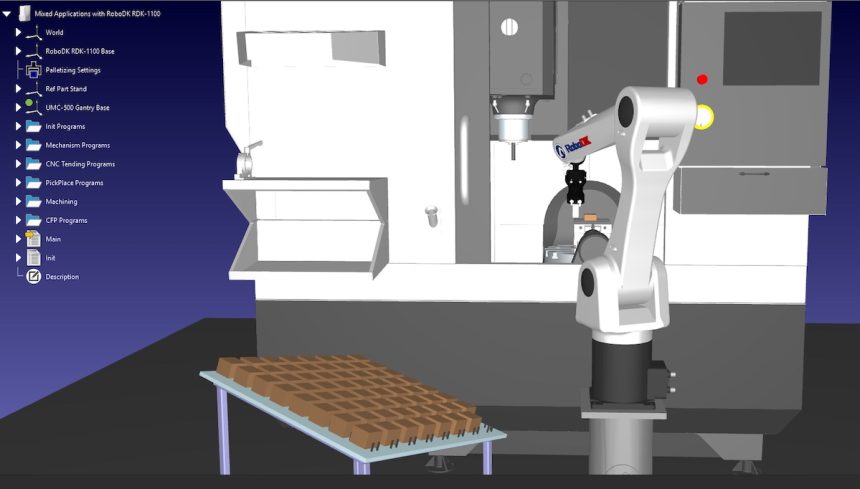
A digital twin is a virtual replica of a real production cell — the robot, the tooling, the conveyors, the parts. Instead of committing to hardware and hoping it fits the workflow, engineers can build the whole setup in software, run it, break it, tweak it and run it again. All the trial and error happens on screen, where the only thing you lose is a bit of simulation time.
The pitch is straightforward: use the twin to evaluate robots and plan applications before writing the cheque. Want to know whether a particular arm can reach every point on a part without colliding with a fixture? Simulate it. Curious how cycle times stack up across different robot models? Compare them virtually, without borrowing a demo unit or paying for a proof-of-concept build.
RoboDK is careful not to oversell the idea. A digital twin, the company stresses, does not necessarily replace a systems integrator — the specialists who physically install, wire and commission a robotic cell. What it does is de-risk the earlier, decision-making stage. By the time an integrator gets involved, a manufacturer already knows which robot suits the job, roughly how the layout should look and whether the numbers add up.
The appeal is easy to understand for smaller manufacturers in particular. Automation has historically been the domain of companies large enough to absorb an expensive misfire. Offline programming and simulation tools flatten that barrier: you can validate an application on a laptop instead of gambling on a shop floor.
There’s a workflow benefit too. Programs written and validated in the virtual cell can, in many cases, be transferred to the physical robot, shortening the gap between planning and production. That means less downtime spent teaching a robot on-site — always a costly proposition when a production line is idle.
None of this makes a digital twin a magic wand. Real-world variables — part tolerances, sensor noise, the occasional human error — still have to be reckoned with once hardware is live. But as a way to explore automation without gambling on it, the case is compelling: model first, spend later, and let the simulation absorb the mistakes so your budget doesn’t have to.