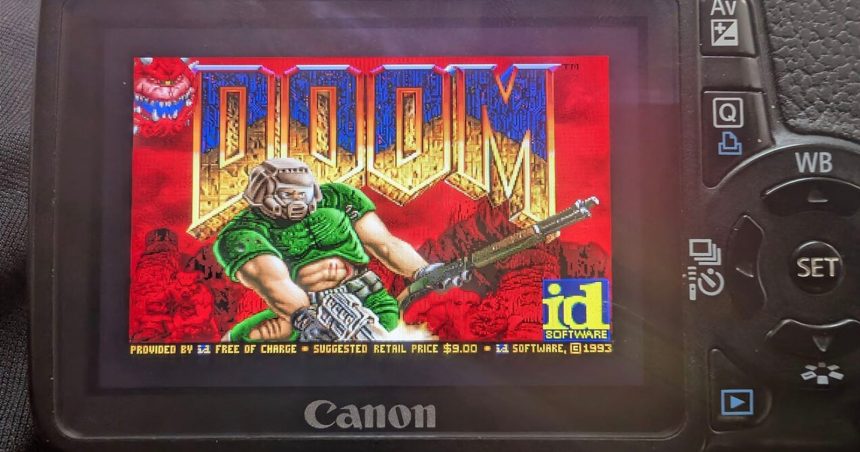
The list of things that can run Doom keeps growing, and the latest recruit is a camera old enough to be in secondary school. Thanks to a fresh community build published on August 20, 2026, the Canon EOS 550D — the 2010 APS-C shooter also sold as the Rebel T2i and Kiss X4 — can now boot up id Software’s 1993 first-person shooter directly on its own hardware.
The trick relies on Magic Lantern, the long-running open-source firmware add-on that unlocks a treasure trove of undocumented features on Canon DSLRs. Rather than replacing the camera’s stock firmware, Magic Lantern loads alongside it, giving tinkerers deep access to the DIGIC processor and the camera’s guts. Someone has now used that access to compile a custom build of Doom that runs on the 550D itself.
It’s a genuinely daft feat when you think about the constraints. The EOS 550D was never designed to be a games console — it’s an entry-level DSLR built to take photos. Its 18-megapixel APS-C sensor and DIGIC 4 image processor were aimed at hobbyist photographers stepping up from a point-and-shoot, not at rendering demons in a corridor shooter.
So how do you actually play? The camera’s 3-inch TFT LCD becomes your display, and the physical buttons that normally cycle through ISO, aperture and drive modes get pressed into service as movement and fire controls. There’s even audio: the 550D’s rear mono speaker, ordinarily reserved for playback of your video clips, handles the game’s iconic shotgun blasts and grunts.
Don’t expect a smooth 60fps experience. This is very much a proof-of-concept in the grand tradition of “but can it run Doom?” — a meme that has seen the game shoehorned onto everything from smart fridges and treadmills to pregnancy tests and calculators. A DSLR is arguably one of the more logical targets, given that it already packs a capable processor, a screen and a speaker into a single body.
If you happen to own a 550D gathering dust in a drawer, the barrier to entry is low. Magic Lantern is free, and the port is a community effort rather than anything official from Canon. That last point matters: installing custom code on your camera is done entirely at your own risk, and it’s not something the manufacturer endorses or supports.
Still, there’s something wonderful about it. A 16-year-old camera, long since eclipsed by mirrorless bodies with vastly more powerful silicon, gets a second life as an improbable gaming machine. It won’t help you nail a wildlife shot, but it will let you clear out E1M1 between exposures — and honestly, that’s reason enough to keep the old workhorse around.