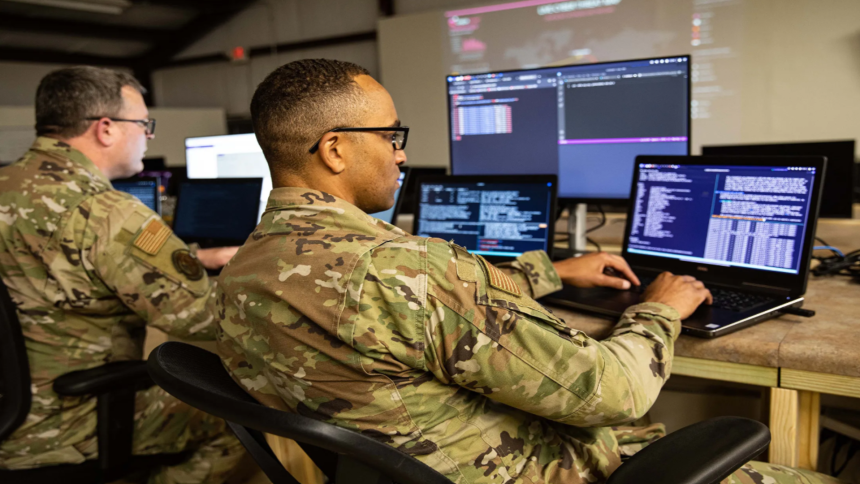
The battlefield of the future may be fought as much in code as in the field, and the US Army is preparing accordingly. Army Cyber Command has begun training AI agents to take on specialized “work roles” alongside human personnel — a shift that could reshape how digital defense and offense operate under military command.
The initiative was outlined by Army Cyber Command’s commander at the TechNet Augusta conference in August 2026. Rather than pitching autonomous systems as replacements for soldiers, the program frames AI agents as collaborators: purpose-built tools slotted into defined cyber functions, working in tandem with the humans who oversee them.
The distinction matters. According to the Army, human personnel retain control over operational risk and decisions — the AI agents handle specialized tasks, but the judgment calls, the accountability, and the trigger on anything consequential stay firmly in human hands. In a domain where a single automated misstep could cascade fast, that boundary is the whole point.
What does an AI agent in a “work role” actually look like? Think of it less as a chatbot and more as a specialized digital operator: a system trained to occupy a specific slot in the cyber workflow, whether that’s monitoring, analysis, or response. The language of “work roles” is deliberate. It maps AI capabilities onto existing human job functions, which makes the integration easier to reason about — and easier to govern.
The logic behind the push is straightforward. Cyber operations move at machine speed, and the volume of activity across military networks long ago outpaced what human teams can manually track. AI agents can absorb the repetitive, high-throughput work — sifting traffic, flagging anomalies, handling routine tasks — freeing human specialists to focus on the decisions that genuinely require human reasoning.
It’s worth being clear about what this is and isn’t. These are internal military systems, not commercial products. There’s no model name to look up, no price tag, and nothing you can buy. The AI agents are being developed and trained within the Army itself for its own operational needs.
The broader significance lies in how the program handles the human-machine balance. Plenty of organizations are chasing full automation; the Army’s approach draws a firmer line, keeping AI in supporting roles while humans own the risk. In a field where trust and control are everything, that’s a notably measured stance — and one that other agencies and enterprises grappling with the same questions will likely watch closely.
As the program moves from conference announcements to deployment, the real test will be how well these agents perform under pressure, and how cleanly the human-in-the-loop model holds up when the stakes are high. For now, the message from Army Cyber Command is consistent: AI does the work, humans make the call.