Ask a room full of robotics companies whether Washington has just handed them a gift or a bill, and the answer comes back a near-perfect tie. MassRobotics, the Boston-based robotics innovation hub, polled its resident startups, corporate sponsors and the wider ecosystem between August 17 and August 23, 2026, collecting 14 responses plus one-on-one conversations from companies ranging in size from 1–5 employees to 200+.
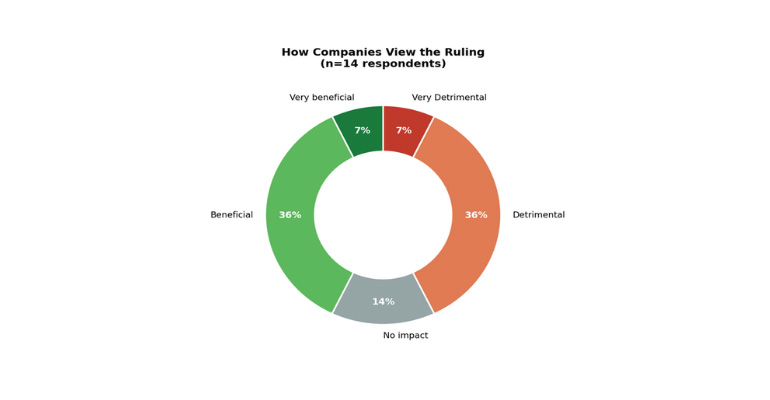
The headline result is the deadlock. 43% of respondents called the FCC ruling “beneficial” or “very beneficial.” Another 43% called it “detrimental” or “very detrimental.” The remaining 14% expect no impact at all.
What splits them is not ideology but the factory floor. “Sentiment tracks closely with a company’s manufacturing footprint,” MassRobotics concluded. “Companies already producing domestically tend to view the ruling as a competitive advantage; companies with foreign-dependent supply chains, even partially, tend to view it as a costly disruption.” Every company manufacturing entirely or mostly in the US reported the ruling as beneficial or better.
The rule behind the argument landed on July 28, 2026, when the FCC added foreign-produced advanced robotic devices — alongside connected power inverters — to its Covered List, closing the door on new device models seeking FCC equipment authorization. The definition casts a wide net: ground-based robots that weigh more than 4.4 lb., carry a sensor that perceives their environment, include connectivity of at least 200 kbps, and run navigation and perception software. To qualify as domestically produced, more than 65% of component costs must be domestic for items delivered in calendar years 2024 through 2028, rising above 75% for items delivered starting in calendar year 2029. The listing is forward-looking: previously authorized models may still be imported and sold, and a limited waiver keeps qualifying software and firmware updates flowing through at least January 1, 2029.
Intent to reshore is running ahead of execution. 29% of those surveyed said they have onshoring plans but have yet to start them, and at least one respondent reported that onshoring simply is not feasible for their business. The parts named repeatedly as difficult or costly to source domestically are the unglamorous ones: motors, sensors, power supplies and DC-DC converters, and robot arms.
Asked what would actually help, members ranked their requests:
- a vetted onshoring supplier network — the single most-requested form of support
- legal and regulatory guidance, including petition assistance
- an extended implementation timeline, with roughly 18 months mentioned
- rescinding the rule outright, on protectionism grounds
- no support at all, from firms that are already compliant
Other worries surfaced too: ambiguity around what “Conditional Approval” actually requires — applications covering robotic devices are reviewed by the Department of War, with a submission deadline of January 1, 2028 — the absence of any distinction between allied and non-allied sourcing, policy volatility that wrecks multi-year planning, the possibility of Chinese retaliation, and fairness questions about competitive timing.
MassRobotics’ own takeaway is that there is no single industry line to take. Its recommendation: “messaging and support should be tailored by manufacturing footprint rather than treated as a single industry position.”