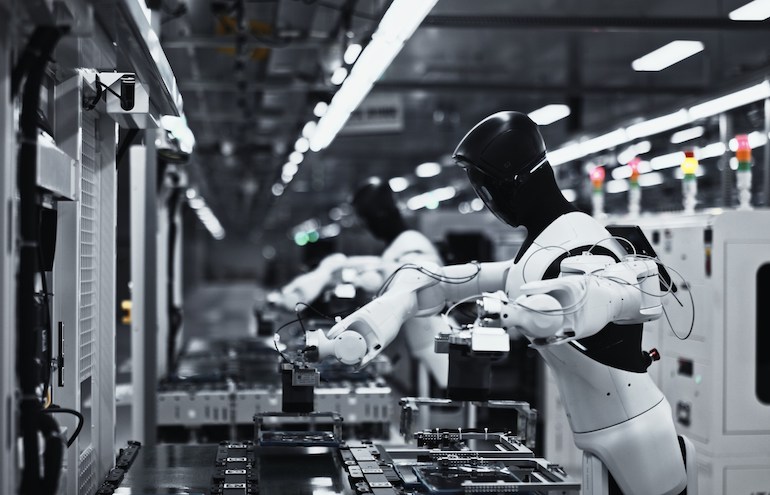
Building robots is one thing. Shipping them at scale is quite another. AGIBOT just crossed a threshold that most embodied-AI startups can only dream about: today, June 28, 2026, the company’s 15,000th wheeled semi-humanoid robot rolled off the production line. That’s not a lab prototype count — it’s a deployment count, and it signals AGIBOT’s shift from R&D and manufacturing into the messier, more demanding world of putting machines to work alongside real customers.
The star of this milestone is the AGIBOT G2, the company’s industrial-grade embodied task robot that was formally launched back in October 2025. On paper, it reads like a serious piece of engineering rather than a stage-demo curiosity.
- 26 degrees of freedom, including 7-DOF force-controlled arms on each side — enough articulation to handle delicate, dexterous tasks rather than just pick-and-place crudeness.
- A 5kg arm payload with sub-millimeter accuracy, courtesy of torque sensors that give the robot a genuine sense of touch and feedback.
- Omnidirectional mobility at 1.5m/s, paired with 360° perception from 3D LiDAR, RGB-D, and stereo cameras — so it can navigate cluttered, dynamic spaces without bumping into the furniture.
- Dual hot-swappable batteries delivering a 4-hour runtime, meaning shifts can continue without dragging the machine off to a charging dock.
- NVIDIA Jetson compute pushing 2,070 TFLOPS FP4 for on-device AI — the kind of horsepower that lets the robot think locally instead of leaning entirely on the cloud.
The wheeled, semi-humanoid form factor is a pragmatic choice. Full bipedal humanoids grab headlines, but legs are expensive, fragile, and power-hungry. A wheeled base sidesteps the balancing problem while keeping the human-like upper body that makes the G2 useful in environments designed for people. For factory floors, logistics, and structured indoor work, that trade-off makes a lot of sense.
None of this comes cheap. The G2 carries a price tag of $100,017.00 USD — a figure that places it squarely in the industrial-investment bracket rather than the consumer aisle. At that price, the 15,000-unit figure is all the more striking, because it suggests buyers are willing to pay for embodied AI that actually shows up and does the job.
Hitting 15,000 robots in deployment is the part that matters most here. Plenty of companies can wow a conference crowd with a single carefully choreographed demo. Far fewer can manufacture at volume, ship to customers, and keep machines running in the field. That transition — from clever engineering to repeatable production — is exactly where most of the embodied-AI hype has historically gone to die.
AGIBOT, for now, seems to be on the right side of that line. Whether the G2 proves itself across thousands of working sites is the next test, but reaching this milestone says the company has cleared the hardest gate: turning robots into products people actually buy.