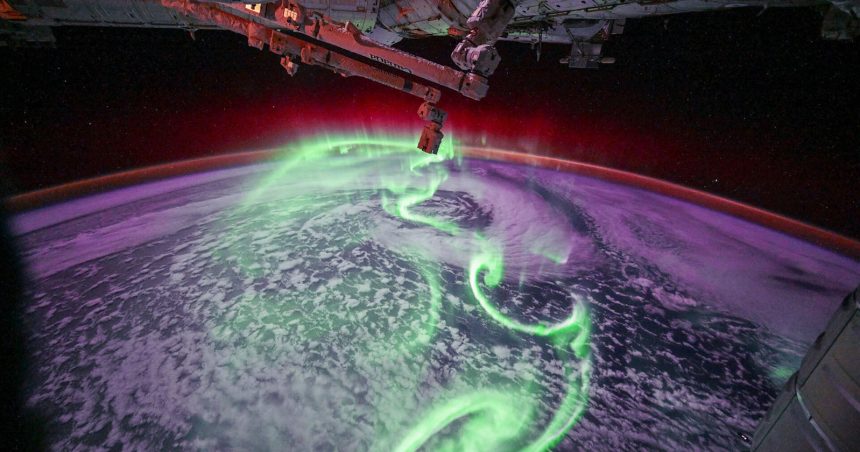
Some views simply don’t translate to a smartphone screenshot. Case in point: the aurora, as seen from roughly 400 kilometers above the planet, where there’s no atmosphere between you and the shimmering curtains of green and violet light.
ESA astronaut Sophie Adenot — active on social media as @soph_astro — has been treating followers to exactly that kind of spectacle from aboard the International Space Station. After she and the European Space Agency shared a batch of aurora stills last month, Adenot followed up with something even more striking: a full video of the phenomenon rippling across the Earth below, posted to her social channels.
The clip shows what still photos can only hint at — the aurora isn’t a static glow but a living, moving thing. From the ISS, the light appears to dance, flowing and pulsing over the curve of the planet as the station races along its orbit. It’s the sort of footage that makes you rethink what “a good view” actually means.
For the uninitiated, auroras form when charged particles streaming from the Sun collide with gases in Earth’s upper atmosphere. Oxygen tends to produce the familiar green (and, higher up, red) hues, while nitrogen adds blues and purples to the mix. On the ground, you need to be near the poles, clear of clouds and light pollution, and a little lucky. In orbit, you get a front-row seat to the entire show at once.
The ISS has long been one of the best aurora-watching platforms humanity has ever built, and astronauts have made a habit of capturing the phenomenon during their stints in space. What makes Adenot’s contribution stand out is the emphasis on motion — a reminder that these are dynamic events, not just pretty pictures.
Beyond the sheer visual payoff, footage like this has real value. Aurora activity is a direct, visible marker of space weather — the same solar activity that can disrupt satellites, communications and power grids down on the surface. Watching it unfold from orbit is both a scientific data point and a genuinely humbling piece of art.
If you’ve never seen an aurora in person, Adenot’s video is the next best thing — arguably better, since it captures a perspective almost no one on Earth will ever experience firsthand. Give it a watch, and maybe start planning that trip north.