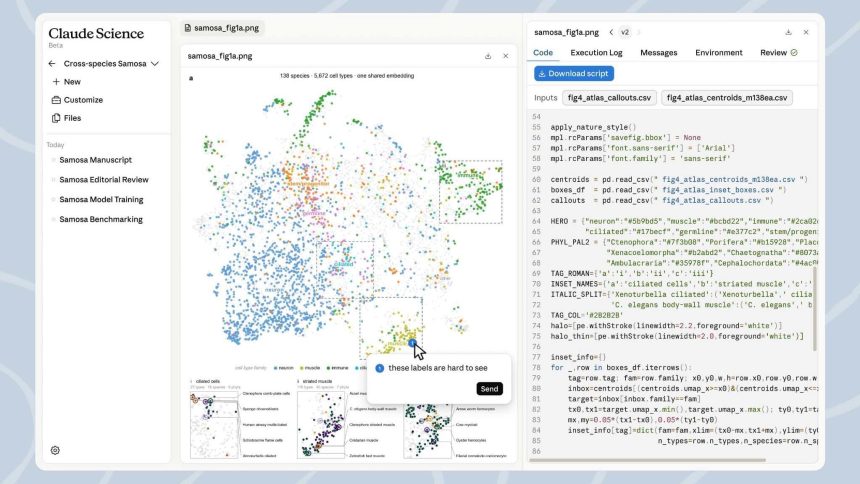
Scientists spend an astonishing amount of time wrestling with plumbing — juggling databases, stitching together packages, and copying results between tools that were never designed to talk to each other. Anthropic’s answer, launched on Tuesday, June 30, 2026, is Claude Science, an “AI workbench” that pulls those scattered pieces into one secure environment.
The pitch is refreshingly practical. Rather than asking researchers to bolt an AI onto their existing chaos, Claude Science consolidates the tools and data inside a single space where Claude can actually reason across them. It arrives pre-configured with more than 60 scientific databases, integrates the packages researchers already rely on, and — crucially for anyone who has to defend their methods to a reviewer — produces auditable artifacts. It also offers flexible access to computing resources, so a heavy workload doesn’t grind a laptop to a halt.
What makes the launch notable is what it doesn’t gatekeep. Claude Science runs on Anthropic’s existing models, including Claude Opus 4.8, with no special access tier or waitlist for the underlying intelligence. If you already pay for Claude, the capability is simply there.
The environment is available in beta now for paying users across the Pro, Max, Team, and Enterprise plans. On the pricing front, that means:
- Claude Pro — US$20/month
- Claude Max — US$100/month
- Claude Team — US$20/seat/month for standard seats
One practical caveat worth flagging: Claude Science runs on macOS and Linux. That aligns neatly with the reality of most research computing, where lab machines and clusters lean heavily on Unix-like systems, but Windows-only researchers will notice the omission.
The broader strategy here is easy to read. General-purpose chatbots have proven they can summarize a paper or draft an email, but they stumble the moment a task demands real domain plumbing — live database queries, reproducible pipelines, and a paper trail that survives peer review. By wiring those requirements directly into the workbench, Anthropic is aiming squarely at researchers who need answers they can cite and re-run, not just answers that sound plausible.
It’s also a quietly ambitious bet on consolidation. A scientist’s workflow today is a patchwork of terminals, notebooks, data portals and reference managers. Claude Science proposes to be the connective tissue between them, with the model acting less like a search box and more like a lab assistant that already knows where everything lives.
Whether it earns a permanent place in daily research routines will come down to how gracefully it handles the messy edge cases that define real science. But as a statement of intent — an AI built for the way scientists actually work, rather than the way marketing decks imagine they do — Claude Science is one of the more grounded launches Anthropic has shipped.