Autonomous delivery robots are brilliant at spotting obstacles and hopeless at understanding them. A lidar point cloud can tell a machine that something is blocking the sidewalk, but it won’t explain whether that something is a puddle, a construction barrier, or a stranger waving it through a gap. Avride’s answer is to bolt a layer of reasoning on top of the raw perception stack — and it lives in the cloud.
The company uses vision-language models (VLMs) to sharpen the environmental awareness of its Avride Delivery Robot R3. Rather than replacing the onboard sensor suite, the VLM acts as a contextual safety net. When the robot’s local systems encounter a situation they can’t confidently interpret, the ambiguous scene gets handed off to a more capable model that can describe what’s actually happening, weigh the context, and suggest a sensible course of action.
It’s a smart division of labour. Fast, low-latency decisions — braking for a pedestrian, steering around a curb — stay on the robot, where milliseconds matter. The heavier, slower work of interpreting a messy urban scene gets offloaded to the cloud, where the model has the horsepower to reason about intent and unusual edge cases. Context, in other words, becomes the deciding factor.
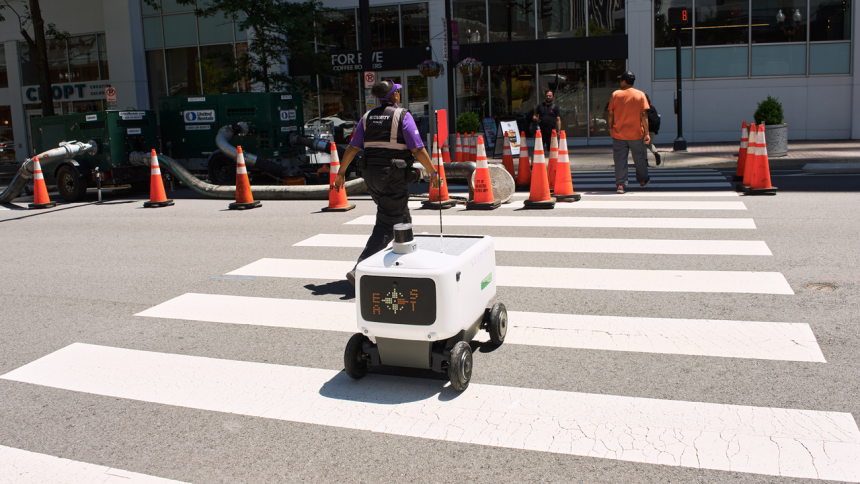
That matters because the R3 spends its days in exactly the kind of unpredictable environments that trip up rule-based systems. The robot travels at up to 8 km/h (5 mph) and covers 50 km (31 mi) on a single charge, with a battery good for up to 12 hours of operation. It carries as much as 25 kg (55 lb) of cargo, with a compartment sized at 520mm × 464mm × 300mm. To navigate, it leans on a mix of lidars, cameras, and ultrasonic sensors — plenty of raw data, but data still needs meaning.
The fleet has been steadily expanding. By the end of 2024, R3 robots were delivering Uber Eats orders in Austin and Dallas, and in February 2025 the service launched for Uber Eats in Jersey City, New Jersey. Today the robots are running in multiple cities, which only raises the stakes for reliable scene understanding — more sidewalks mean more oddball situations no engineer could have scripted in advance.
Using large VLMs as a fallback is a pragmatic middle path. Full end-to-end AI driving remains a moonshot, and hand-coded logic can’t anticipate every crosswalk mime or misplaced traffic cone. By reserving cloud reasoning for the genuinely confusing moments, Avride keeps latency manageable while giving its robots a way to ask, in effect, “what am I actually looking at?”
It’s a reminder that in real-world autonomy, perception is only half the problem. Knowing that an obstacle exists is easy. Knowing what it means — and what to do about it — is where the hard work still lives.