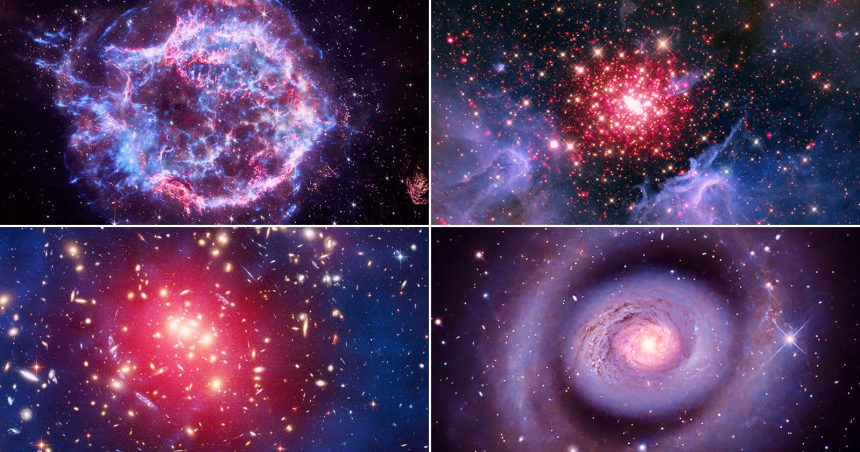
NASA marked the United States’ 250th anniversary on July 4 by turning its most powerful X-ray eye on the cosmos and dressing the results in patriotic colors. The Chandra X-ray Observatory released four new images that render the violent, high-energy Universe in resplendent red, white, and blue.
It’s a fitting bit of showmanship from a telescope that has spent more than two decades staring at some of the most extreme phenomena in existence. Chandra doesn’t see visible light the way your eyes — or a backyard telescope — do. Instead it detects X-rays, the radiation streaming off superheated gas, exploded stars, and matter swirling toward black holes at temperatures reaching millions of degrees. Those X-rays get translated into color, and for this celebration the palette leaned firmly into red, white, and blue.
The result reads like a fireworks display staged across the galaxy, except every burst is real and each one is spewing energy on a scale no pyrotechnician could dream of.
A quick reminder of what’s doing the looking here: the Chandra X-ray Observatory, originally known as the Advanced X-ray Astrophysics Facility (AXAF), is a Flagship-class space telescope. NASA launched it aboard the Space Shuttle Columbia on July 23, 1999, and it has been operating as a space-based observatory ever since. Because Earth’s atmosphere blocks most X-rays, a mission like this only works from orbit — which is exactly why Chandra has become one of the go-to instruments for astronomers chasing the Universe’s most energetic events.
What makes releases like this more than a novelty is the science baked in. The same data that gets colorized into a holiday-friendly image also maps how gas moves through the wreckage of dead stars, how galaxies grow, and how black holes shape everything around them. The red-white-and-blue treatment is a presentation choice; the underlying photons are the genuine article.
For anyone who thinks of telescopes purely in terms of optics and megapixels, Chandra is a useful corrective. It’s a different kind of camera entirely — one tuned to a slice of the spectrum humans can’t perceive, capturing a Universe that would otherwise stay invisible. And every so often, as with this birthday set, it hands that hidden Universe back to us in a form anyone can appreciate.
Four images, one very old telescope, and a cosmos that keeps putting on a show. Not a bad way to celebrate 250 years.