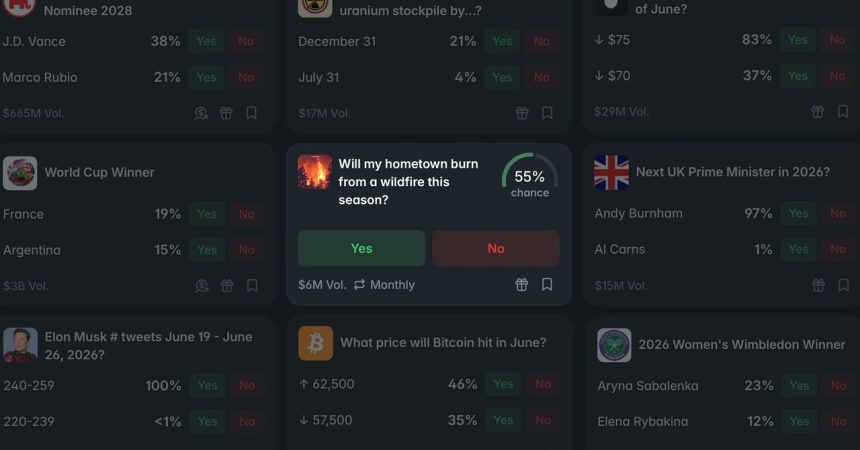
Prediction markets have wagered on elections, sports, oil prices and even disease outbreaks. Now they’ve found a grimmer subject: wildfires. And a new platform wants to make betting on them a business of its own.
Wyldfyre bills itself as the world’s first standalone prediction market dedicated to wildfire risk, launched around June 29-30, 2026. Its tagline is blunt: “You can’t predict wildfire. But you can trade on it.” The platform claims to price county and city wildfire risk in real time, pulling in hotspot data from NASA and fire perimeters from the National Interagency Fire Center to help users forecast where flames will spread next.
Here’s how these markets work. Questions are framed as “yes” or “no,” with contract prices floating between $0 and $1. A 50-cent “yes” contract means bettors collectively estimate a 50 percent chance the event happens. The house takes a cut of every wager.
For now, Wyldfyre only lets users simulate trading — real-money betting is listed as “coming soon.” The platform is strikingly opaque: no owner is named, no contact information is listed, and following press coverage the site went offline entirely. It frames itself as a public good, promising to turn “collective intelligence into better wildfire forecasting — one trade at a time.”
The agencies that actually fight fires aren’t buying it. The US Forest Service told reporters it does not use prediction-market data and “does not rely on any system that treats wildfire as an event for speculation.”
This isn’t hypothetical territory. During the January 2025 Eaton and Palisades fires — which destroyed more than 16,000 structures and killed 31 people — Polymarket listed nearly 20 wildfire questions. How many acres would the Palisades Fire burn by Friday? Would it reach Santa Monica by Sunday? People spent $1.2 million betting while thousands of Angelenos raced to evacuate.
Survivors are appalled. “My first take is that it’s morally reprehensible,” said Sylvie Andrews, who lost her Altadena home in the Eaton Fire. Susan Sherman, who lost her family’s Pacific Palisades home her parents had owned since 1963, called it “crass and heartless.”
The deeper worry is arson. Unlike a hurricane or a flood, a fire can be started or fanned by a single person in minutes — creating a perverse incentive for a bettor to nudge an outcome. Firefighters or land managers with inside knowledge could effectively engage in insider trading. “A market that might support that kind of activity,” said ethicist Ann Skeet, “is a dangerous market.”