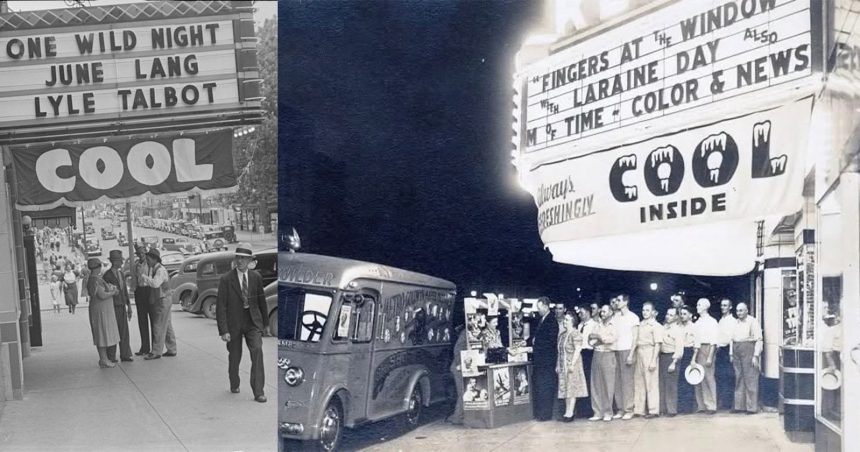
Before Jaws and Star Wars, before the multiplex and the popcorn upsell, the American summer was a dead zone for cinema. In the 1920s, theaters were dark, windowless boxes that turned into ovens once the temperature climbed. Many simply shut their doors for the hottest months. Nobody wanted to pay to sweat in the dark.
A recently curated series of photos from the Library of Congress shows how that changed. Snapshots from the 1930s and ’40s — the Fox Theater in Montrose, Colorado in 1940, a Chicago house the same year, a theater near Lancaster, Ohio in August 1938 — all share one detail on their marquees: air conditioning, advertised as loudly as the films themselves. “Always refreshingly cool inside,” boasts one board photographed around 1940.
The turning point came earlier. Balaban and Katz opened the world’s first mechanically cooled movie theater in Chicago in 1917, but the real breakthrough belonged to Willis Carrier, the inventor of modern air conditioning. In 1925 he installed a more sophisticated system in the Rivoli Theatre in Times Square.
The rollout was not smooth. The Rivoli opened on Memorial Day weekend in 1925, and at first the air conditioning didn’t work. As moviegoers filed in, they pulled out handheld fans to cool themselves. Then the unit finally kicked in — the fans dropped, and the audience settled into the film with a focus the summer heat had never allowed.
Watching this was Adolph Zukor, head of Paramount Pictures, and he grasped the implication instantly. The theater wasn’t just selling a movie anymore. It was selling coolness itself — a refuge from the streets outside. Summer, once the industry’s slowest stretch, could become its busiest. Carrier reportedly persuaded Paramount to install air conditioning in the Chicago Theatre on State Street while the building was still under construction.
The economics followed the technology. In that era only a handful of theaters across the U.S. had cooling installed, which made it a genuine draw rather than a background comfort. One of the earliest films marketed on the summer-crowd logic was the 1943 war drama Bombardier, billed as the “blockbuster of all action-thrill service shows.”
It took until the 1970s for the modern template to lock in. Jaws and Star Wars defined the quintessential summer blockbuster — the tentpole release that now anchors the Hollywood calendar. By then, ironically, air conditioning was spreading into American homes, weakening the theater’s monopoly on cool air. But the habit was already baked in: summer meant going to the movies.
You can draw a straight line from those Depression-era marquees hawking their cooling systems to the billion-dollar franchise machine of today. The summer blockbuster wasn’t born from a screenplay or a studio strategy. It was born from a compressor.