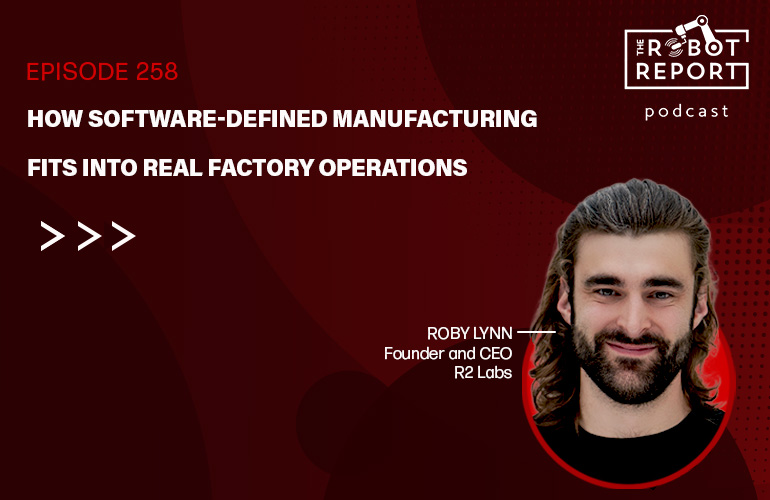
Walk into most factories and you’ll find a technological archipelago: PLCs from one era, robots from another, and analytics tools bolted on top that barely speak the same language. Roby Lynn of R2 Labs argues that the fix isn’t ripping any of it out — it’s giving the whole mess a common software layer that can finally reason across the divide.
That’s the promise behind software-defined manufacturing, and it’s less about replacing hardware than about rethinking who’s in charge. Instead of logic locked into fixed controllers, the intelligence moves up into flexible software platforms that coordinate workflows, capture operational context, and handle real-time execution across the plant. The programmable logic controllers stay. The robots stay. What changes is that they stop operating as isolated islands.
Lynn’s central point is that fragmentation is the real enemy on the factory floor. A PLC knows the state of a valve. A robot knows its own joint positions. An AI model might spot a defect on a camera feed. But historically, none of them share a coherent picture — and stitching that picture together by hand is slow, brittle, and expensive. R2 Labs positions itself as the connective tissue: a way to bridge PLCs, robots, and AI so they behave like parts of one system rather than a pile of vendor silos.
The broader industry momentum backs this up. Software-defined automation is increasingly treated as the foundation of the next era of industrial control, shifting decision-making onto software platforms that can run on servers or in the cloud. The competitive edge in manufacturing, the thinking goes, no longer comes purely from the automation hardware you buy — it comes from the software layers orchestrating everything on top of it.
Why does that matter beyond the plant manager’s spreadsheet? A few reasons stand out:
- Flexibility: software-defined control makes it far easier to reconfigure a line for a new product without re-wiring physical logic.
- Context: unifying data streams means AI has something meaningful to work with, rather than disconnected fragments.
- Longevity: because the approach layers over existing equipment, factories don’t have to scrap working machinery to modernize.
The catch, as always, is trust. Manufacturing runs on uptime and safety margins, and shop-floor engineers are rightly skeptical of anything that abstracts away the deterministic behavior they depend on. The success of software-defined manufacturing hinges on proving it can deliver the coordination and intelligence Lynn describes without introducing latency, unpredictability, or a single point of failure.
What R2 Labs is really selling, then, isn’t a gadget — it’s a philosophy about where the brains of a factory should live. If the past few decades were about automating individual tasks, the argument here is that the next chapter is about making all those automated tasks finally understand each other. On that front, the shop floor is watching closely.