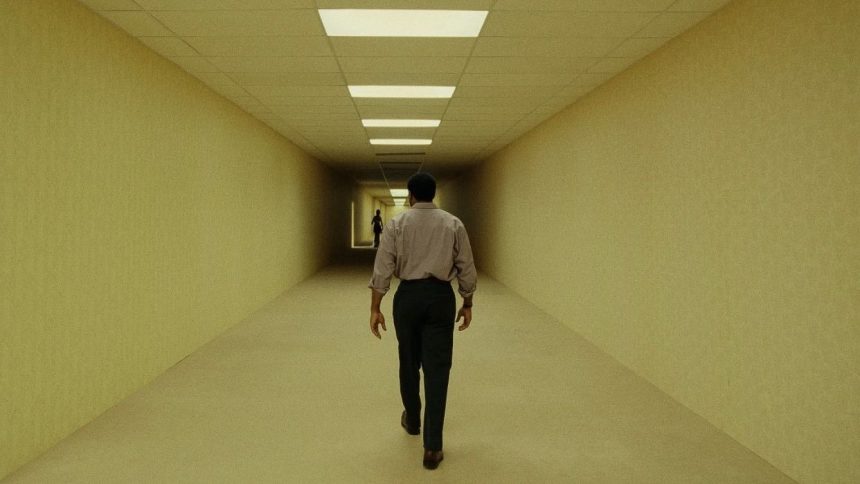
The Backrooms film may divide audiences, but there’s one element that follows you out of the cinema and keeps humming in your skull long after the credits roll: its soundtrack. Born from a 2019 4chan post about an endless expanse of mono-yellow rooms, buzzing fluorescent lights and the stink of old moist carpet, the internet urban legend has been turned into a feature by A24 and North Road Films — and the score is arguably its most successful translation of that uneasy, liminal feeling.
Composed by director Kane Parsons and Canadian musician Edo Van Breemen, with a one-off contribution from Jeffrey Innes, the Backrooms (Original Soundtrack) leans hard into dark-ambient electronic textures. Two tracks break the mould exactly as their names suggest — Pirate Shanty and Cafe Bossa v1 — but the rest is designed to unsettle.
No comfort, no main theme. Repetition is deliberately minimised here. There’s no traditional recurring motif to hold onto; the themes that do return are frequently pitch-modulated, sliding woozily between tones. On Furniture Lament, that instability gives the impression of a foundation that keeps shifting beneath your feet — familiar, yet never quite settled.
The production choices reinforce the concept. Glitching synths have been run through old tape machines for an earthy warmth and warble, while woodwind, strings and clanging pipes — as heard on Basement Land — are heavily filtered and processed, sometimes past the point of recognition. It’s the sonic equivalent of the backrooms aesthetic itself: everyday objects twisted subtly out of shape, so that something feels wrong without you being able to name it.
A stereo mix that punches above its channels. What impresses most is how much spatial trickery the soundtrack pulls off in plain stereo. Auditioned across gear ranging from Sennheiser Momentum 5 Wireless headphones to the high-end PMC M2B SE speakers, it repeatedly triggered that instinct to turn around and check whether a sound came from inside the room.
On Quiet Wall In Dark Room, transitions between huge banks of strings, airy ambience and low rumblings genuinely evoke the sensation of moving through separated spaces. Later in the same track, phase and panning tweaks make a glitching synthesizer feel as though it’s playing from inside your head. Not exactly pleasant — but undeniably clever.
The combined effect lands squarely in line with the origins of the backrooms myth: a longing for and discomfort around a simpler but not-so-distant past. For fans of ambient music who don’t mind being spooked, this is a rewarding, deeply evocative listen — best enjoyed, if you dare, in an eerie empty space of your own. Just make sure you can find your way back out.