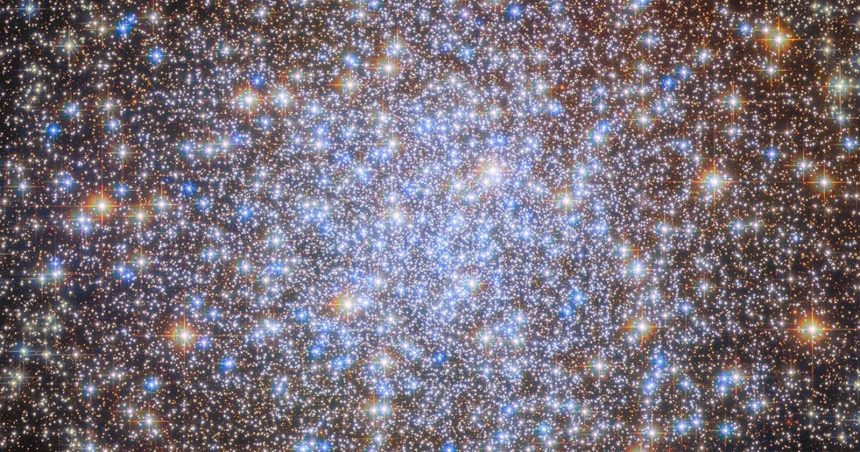
The veteran NASA/ESA Hubble Space Telescope refuses to slow down, and its latest target is one of the night sky’s most lavish ornaments. The orbiting observatory has captured the globular cluster NGC 6723, a stellar swarm so densely packed that astronomers have nicknamed it the Chandelier Cluster.
The name fits. Globular clusters are gravitationally bound spheres holding hundreds of thousands — sometimes millions — of stars, all crammed into a region just a few dozen light-years across. In Hubble’s view, each pinprick of light reads like a single bulb on an enormous cosmic fixture, with the brightness piling up toward a blazing core where the crowding becomes almost impossible to resolve.
What makes images like this so striking isn’t just the aesthetics. These ancient clusters are some of the oldest structures in the galaxy, populated by stars that formed early in cosmic history. Studying how they’re distributed and how they glow helps researchers piece together the timeline of the Milky Way itself.
And then there’s the hardware story. Hubble launched in 1990, and the fact that it’s still returning postcard-quality portraits of objects like NGC 6723 is a small engineering miracle. Decades of servicing missions and clever instrument upgrades have kept the telescope competitive long into the era of its larger, infrared-focused successor.
- Target: globular cluster NGC 6723, a.k.a. the Chandelier Cluster
- Why it matters: dense, ancient star clusters are key markers of galactic age and structure
- The instrument: the NASA/ESA Hubble Space Telescope, still operational decades after launch
For all the talk of newer space observatories stealing the spotlight, Hubble keeps proving there’s plenty of life left in the old optics. The Chandelier Cluster is simply the latest reminder that a telescope built last century can still hand us images that stop you mid-scroll.