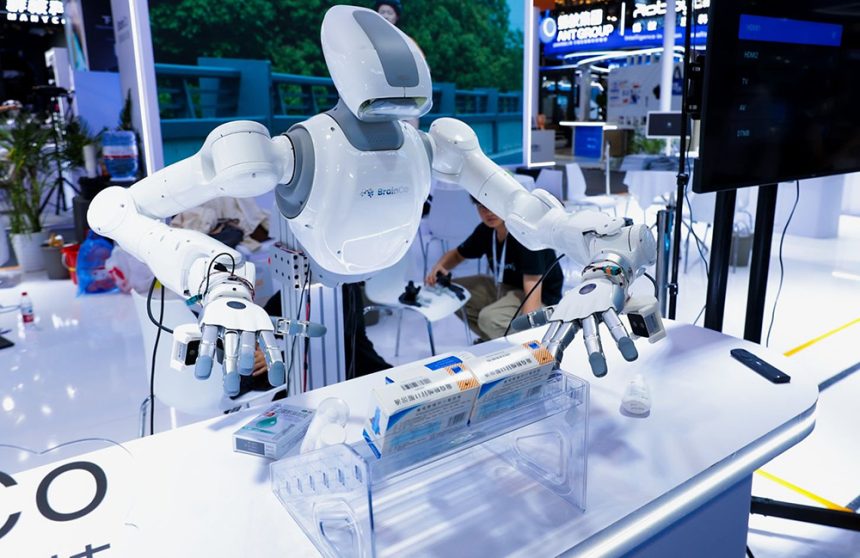
Grabbing a cup or picking up an apple sounds trivial — until you try to do it with your mind alone. That was the headline demonstration when BrainCo took the stage at the World Artificial Intelligence Conference (WAIC) in Shanghai, unveiling its Brain-Controlled Robot AI Platform on July 21, 2026.
The premise is refreshingly direct. A user wears an EEG headset that captures raw brain signals, and BrainCo’s AI-based algorithms handle the hard part: decoding those neural patterns to work out what the person actually intends, then translating that intent into physical robotic action. No joystick, no controller, no muscle input — just the electrical chatter of the brain, interpreted in real time.
During the live demo, a mind-controlled robotic arm carried out tasks that demand genuine precision. Reaching for a cup and lifting an apple may look effortless when a human hand does it, but for a machine driven by decoded brainwaves, each grasp is a small triumph of signal processing. Getting the timing, force and trajectory right from noisy EEG data is exactly the kind of challenge that has kept brain-computer interfaces stuck in the lab for years.
What makes BrainCo’s approach notable is that it isn’t tied to a single bespoke robot. The company says the platform is compatible with a wide range of commercially available machines, including:
- Humanoid robots
- Robotic arms
- Legged robots
That flexibility positions the platform as a kind of universal control layer — a bridge between human intention and whatever hardware happens to be on the other end. In principle, the same headset and decoding stack could animate a dexterous arm on a workbench one day and a legged robot the next.
BrainCo, founded in 2015, has spent the better part of a decade working on neural interfaces, and this platform reads as the natural convergence of two fast-moving fields: brain-computer interfaces and increasingly capable robotics. Pair a system that can reliably read intent with a fleet of off-the-shelf robots that can execute it, and the applications start to write themselves — assistive technology for people with limited mobility being the most obvious and most compelling.
A word of realism, though. This is a research and development platform, not a product you can order. There is no consumer availability and no price, and the WAIC showing was a demonstration of what the technology can do rather than a launch. The gap between a controlled stage demo and a robust, everyday device is real, and BrainCo hasn’t outlined a timeline for closing it.
Still, watching a robotic arm pick up an apple on nothing but a thought is the kind of moment that makes the future feel a little closer. If BrainCo can carry that reliability out of Shanghai and into the world, the humble act of grasping a cup might become one of the more quietly revolutionary demos of the year.